Showing posts with label - 2000-04. Show all posts

March 18, 2012

Peugeot 607

A little history

No French manufacturer has been able to offer a car in the same field as Mercedes-Benz or BMW for decades, though all of them dream of it. Apart from the Citroën CX, all other upper range models over the years, the Renault 25 then Safrane, the Citroën XM and C6 or the Peugeot 605 have seen their success limited to the sole France, while being virtually absent on export market. I won’t include in this list the Renault Vel Satis, which was a failure even in its own native country.

Helped by its reputation as a builder of tough and very conventional automobiles, Peugeot has possibly been the most perseverant. After the demise of the 604, it took four years to see the introduction of its successor, the 605. Despite its many qualities, it was doomed by uninspired styling, due to Pininfarina but too close from the lesser 405, and poor quality – a typical French problem that was totally unacceptable for a car having such ambitions.

The 605 finally retired after a ten-year career at the end of 1999, and was immediately replaced by the 607. The new car retained the excellent platform of its predecessor, but hidden under a brand new body. A particular effort had been made to improve the quality of the car. The top-level V6 version, with a displacement of 3.0-litre and 207 hp, could reach 240 kph – enough for cruising on an Autobahn, it was thought in Sochaux. But once again, this didn’t prove enough. Peugeot’s main problem was the lack of image attached to its name, while reputation is a major criterion for a buyer of a luxury car. Sales remained modest, in particular outside France’s borders, though on the other hand the 607 was rather popular as a taxi, a traditional market for its manufacturer.

Production of the Peugeot 607 has been stopped in June 2010. Though a replacement has been contemplated, the dire economic crisis drove Peugeot to be cautious and give up any plan for such a low-volume vehicle. In the end, the 508 served as a successor to both the 407 and the 607, placing Peugeot in a situation somewhat similar to the one it experienced during the Eighties, when a V6-powered version of the 505 was given the task of replacing the 604. This leaves the hope that within a few years, if the situation allows it, Peugeot will return once again to this market.

About the model

Model: Peugeot 607
Year: 2000
Maker: Norev
Scale: 1/43
Distributed by: Hachette as no.49 of its Collection Peugeot press series
Acquired: brand new, in January 2008, in Souillac, France

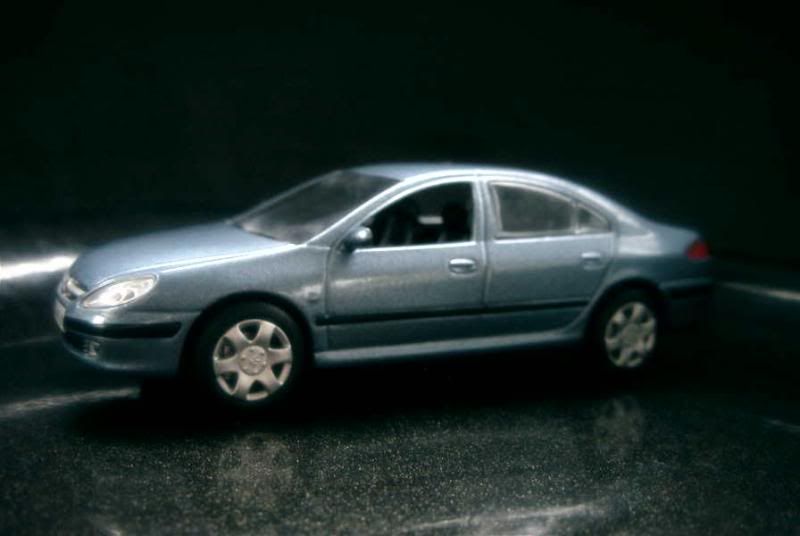
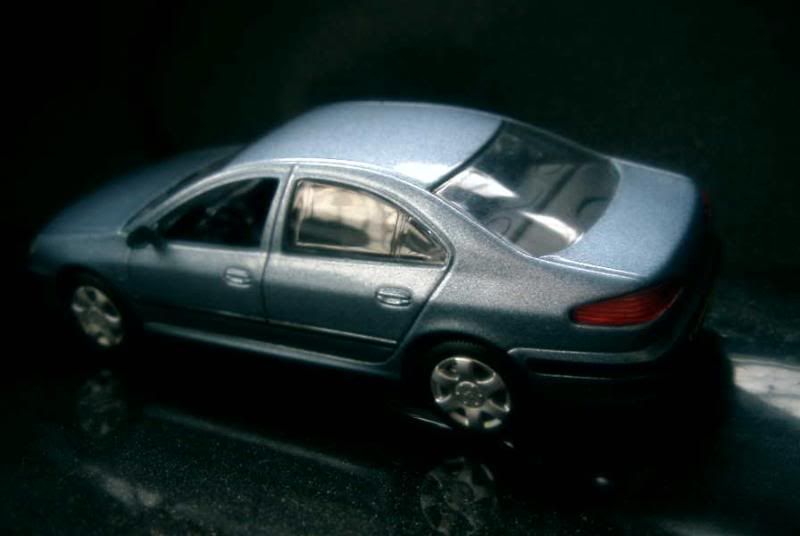
An accurate but rather plain rendition of the Peugeot 607. I have a strange feeling about the rear side windows. As usual with Norev models built for press series, this one does not have a "glass" part inside of its mirrors. On these pictures, I also find that the wheels seem of a rather large diameter, but I should have a second look at the actual model. My rating is 12/20.
Photobucket

Photobucket

November 20, 2011

Ford Crown Victoria

Quite discreetly, Ford has recently pulled the plug on the very last of the “real” American cars, when the final Ford Crown Victoria left the assembly line. So more than a simple post, here is an homage of sorts to an era now over.

A little history

To say the truth, even when the Ford Crown Victoria and its rival the Chevrolet Caprice appeared twenty years ago, there were doubts about the future of these huge dinosaurs, still built with separate frames and fitted with transmissions to the rear wheels. Somehow, they succeeded in surviving longer than many may have thought, thanks to the faithfulness of many Floridian or Californian seniors, who have never driven anything else than this type of cars for their whole lives, but whose market was getting smaller year after year; and even more significantly due to the high demand from law enforcement agencies and taxicab operators.

In March 1991, both the Ford Crown Victoria, which dropped at this point its traditional “LTD” name, and its fancier counterpart the Mercury Grand Marquis received a brand new body, more rounded and aerodynamic than their dated predecessors, but still based on the “Panther” chassis used for full-size sedans since the late Seventies. This followed a similar move by General Motors, which had just updated its line of full-size models – Chevrolet Caprice, Oldsmobile Custom Cruiser and Buick Roadmaster, and the earlier introduction of Ford’s luxury model, the Lincoln Town Car, also based on the Panther platform. Despite its older underpinnings, the Crown Victoria enjoyed a brand new 4.6-litre “modular” engine, and optional ABS and traction-control systems. Its styling was an apt balance of modern and conservative, and this proved perfect as the bathtub-like body of the Caprice had been poorly received. Within months, the Crown Victoria led the market well ahead of its GMC rival which, after a botched restyling, disappeared following the 1996 model year. From then on, the Crown Vic’ became the only option for a traditional V8 automobile in its price range.

For the 1998 model year, the styling of the Crown Victoria was largely revised, and the car benefited from an improved suspension. While the general public was less and less attracted by the heavy car, it was still hugely popular with policemen – to whom Ford proposed the Crown Victoria Police Interceptor version – and taxi drivers. It also enjoyed a healthy following in the Middle East, which actually had soon become its only export market. At the end of the 2007 model year, the Crown Victoria stopped being available to private buyers in America, those being redirected towards the Mercury Grand Marquis, and remained only available for fleets and export markets.

In 2008, Ford decided to concentrate the production of all its Panther-based cars in its St. Thomas plant. The Canadian unions were rather anxious about the future of the car, or more specifically those of thousands of workers at this Ontario factory. Ford reassured them by announcing that large amounts of money would be invested to update the car. This was nothing but a lie. The last Mercury Grand Marquis was produced in January 2011, the brand being discontinued. It was followed by the last Lincoln Town Car in August, the car not being in conformity with new safety regulations imposed by Washington on all cars built for model year 2012. Though the Ford Crown Victoria was also affected by these new rules, it was maintained in production until September to fulfil foreign orders. On September 15, 2011, the very last Crown Vic’ left the assembly line of a factory due to close.

About the models

Model: Ford Crown Victoria Police Interceptor
Year: c.1997
Maker: Motor Max
Scale: 1/18
Distributed by: Motor Max, ref. 73125
Acquired: brand new, in February 2005, in Manila, Philippines

A nice surprise among Motor Max range of traditionally poorly assembled and painted die-casts. Their Crown Victoria certainly isn’t outstanding, but very few reproaches can be made to it. A rare feature for a model in this price range, it offers four opening doors. My rating is 13/20.

Photobucket

Photobucket

Photobucket

Photobucket

Photobucket

Photobucket

Photobucket

Model: Ford Crown Victoria
Year: 1998
Maker: Ixo
Scale: 1/43
Distributed by: Altaya as no.52 of its Taxis du Monde press series
Acquired: brand new, in March 2004, in Souillac, France

Altaya could hardly avoid proposing a Crown Victoria in its series about world taxies and cabs, as the large Fords have replaced the traditional Checkers as the iconic transportation of the New Yorkers. Its die-cast has been provided to the Italian distributor by Ixo. Again the rendition of the large car is accurate enough to be worth 13/20.

Photobucket

Photobucket

Photobucket

Model: Ford Crown Victoria
Year: 2002
Maker: Ixo
Scale: 1/43
Distributed by: Altaya as no.70 of its Taxis du Monde press series
Acquired: brand new, in December 2004, in Souillac, France

In its pursuit for more money pocketed from its faithful customers Altaya has extended its taxi series by offering new decorations to models already proposed earlier in different forms. The Crown Victoria was one of those, being sold a second time as a Dubai taxi. Decoration is somewhat simpler than its New York’s counterpart’s, but overall level of quality still deserves a 13/20.

Photobucket

Photobucket

September 22, 2010

Honda Accord (from 2002 on)

A little history

One of the most iconic cars to ever bear the Honda name, the Accord has been part of the Japanese constructor’s range since 1976. By the early Nineties, global success brought a determining split between the European and American Accords. Honda started production in Swindon, United Kingdom of an Accord that was definitely dissimilar from its counterpart sold in Japan and North America. To make thinks even more complicated, another split saw the next generation of the car being different on the American and Japanese markets… This confused situation lasted until September 2002, when the seventh-generation Accord was launched. The Swindon factory halted production of the model, and all Accords sold in Europe were made in Japan. On the other hand, the American model produced in Ohio continued to be distinct, and grew slightly bigger.

The Japanese Accord (also called Accord Euro) was available as a four-door saloon and a striking estate. Base engine was a 2.0-litre four, from which a potent 220 hp version was developed as the Euro-R, a variant that was carried over from the previous model. V6 engines remained unavailable in a car that was designed with the middle class in mind.

The American Accord didn’t see a station wagon version, but a two-door coupe, based on the shorter chassis, supplemented the four-door sedan. Standard engine was the very same 2.4-litre four that topped the Japanese and European engine ranges, while American buyers had the possibility of fitting a V6 displacing three litres under their bonnets.

In short, both Accords were willing to answer the requirements of the same markets, that of middle-class families looking for an upper mid-range saloon, though this identical need requested a larger car in America than in the rest of the world.

So I said that the introduction of the new Accord in 2002 simplified things... Well, not fully, as both cars were sold on the main market of their counterparts. That is, the Accord Euro became available on the American soil in 2004, but rebadged as the Acura TSX. The other way around, the American Accord was sold as the plush, V6-powered Honda Inspire in Japan from June 2003.

A new Accord, the eighth generation, was put on sale in December 2007, Honda retaining the U.S./Japan differentiation. Though its design is roughly similar, it is more radically edged and, consequently, more aggressive. The American version grew larger than ever, gaining a whopping ten centimetres in length and receiving a larger 3.5-litre V6 as its optional block. Though a station wagon Accord is still not available in North America, a crossover known as the Crosstour has been added at the end of 2009.

About the models

Model: Honda Accord Tourer
Year: 2003
Maker: Ebbro
Scale: 1/43
Distributed by: Ebbro, “Hot!” series ref. 433
Acquired: brand new, in December 2006, in Hong Kong, S.A.R.

A superb model by Ebbro. I promise that I tried hard, but failed to find anything to reproach to this die-cast. It’s a well-deserved 16/20.

Photobucket

Photobucket

Model: Honda Inspire V6
Year: 2003
Maker: Ebbro
Scale: 1/43
Distributed by: Ebbro, “Hot!” series
Acquired: brand new, in December 2006, in Hong Kong, S.A.R.

Ebbro proposes an Inspire that is almost equally seductive: 15/20.

Photobucket

Photobucket

September 16, 2010

BMW C1

A little history

With increasing traffic congestion downtown many of the world cities and growing environmental concerns, many automobile drivers started turning to scooters and even bicycles as their daily commuting vehicles during the Nineties. Experience on two wheels being rather limited for these newly converted users, fears about safety quickly arose.

One of the three constructors to be equally present on two- and four-wheel markets, BMW decided to bridge the gap between the two concepts with a revolutionary vehicle, no less. Unfortunately, it failed – most probably sometime in the future it will be seen as too much ahead of its times.

Actually, BMW was even ahead of the demand for a two-wheel city vehicle when it unveiled its C1 prototype in Cologne as early as in 1992. The C1 was, basically, a scooter, but one with… a roof.

In fact, the C1 had received more than a simple roof. Its driver would seat in a reinforced cage made of aluminium, and behind a crumple zone. He would also be protected by bars set at shoulder height, and fastened to his seat by aviation-type harnesses. The first goal of the C1 was to demonstrate superior safety standards, and it passed crash tests with flying colours, proving to be as safe as a city car. Based on these results, BMW claimed the C1 could be driven without a helmet. Another potential burden for defectors from the automobile side being operating a motorcycle transmission, BMW fitted its C1 with a CVT system which allowed for extreme ease. Furthermore, the roof offered some degree of protection against the rain.

By the late Nineties, the production C1 was finally ready and the time seemed ideal for its launch. The new scooter was powered by a 125cc mono-cylinder good for 15 hp; top speed, if this ever matters for a city vehicle, was advertised at 106 kph. Rather than producing an in-house engine, BMW purchased its blocks from Rotax, an Austrian company notably involved in ultralight aircraft. Subcontracting didn’t stop there, as actually the C1 production as a whole was entrusted to Bertone in Italy. The C1 was introduced in late 1999, and sales began early in 2000 in most European markets.

Apart from its bold design, two factors played against the C1’s commercial success. One was its price, much higher than any other rival scooter in the 125cc class. The other one was the reticence from several countries’ authorities to alter the regulations regarding the use of helmets. In the United Kingdom in particular, rigid laws virtually excluded the C1 from the country.

Despite the 2001 launch of a slightly more muscular version, named “200” but actually powered by a 17.5 hp, 175cc engine, sales were sluggish. BMW threw the towel during 2003. Did the Bavarian give up all hopes on its C1? Apparently not, as a lightened version powered by an electric motor, the C1-E, as been presented as a concept in 2009. Though the company providing its power, Vectrix, has since then filled for bankruptcy, it isn’t impossible that this pioneering BMW be resurrected one day.

About the model

Model: BMW C1
Year: 2000
Maker: Maisto
Scale: 1/18
Distributed by: Maisto, ref. 39350
Acquired: brand new, in February 2005, in Manila, Philippines

Accurate enough, though as it is common with Maisto the “chromed” parts look way too much like plastic rather than metal. My rating is 11/20.

Photobucket

Photobucket

Photobucket

Photobucket

September 10, 2010

MG-Lola EX257

A little history

After two tumultuous decades, MG seemed on the right track by 2000. The sporty MG F sold in volumes unthinkable just a few years before, while a full range of cars was about to be added. All what was missing to restore the old constructor’s glory was a successful racing program.

MG having no recent experience on the track, it turned to the world’s specialist of the turnkey racing car: Lola. The constructor’s ambition was to enter sportscar racing, but in the smaller, more accessible LMP675 class. Lola had just built two models of a spyder designed for LMP900, and incorporated as many elements as it could into its new racer, internally known as the B01/60, but christened EX257 by MG. The engine was equally called MG, though once again the constructor’s input was limited. Dedicated company A.E.R. was chosen to provide the EX257’s block, a turbocharged 2.0-litre inline four able to provide outputs in the vicinity of 500 hp.

The MG EX257 made its debut at the 2001 Le Mans 24 hours, which wasn’t an easy task. The two cars entered made a strong demonstration, proving themselves to be faster than any other car in their class. Unfortunately the insufficiently tried machines both retired in an event that, actually, put great strain on all LMP675 entrants.

In 2002, the car competed in the American Le Mans series through private entrants, and immediately proved highly competitive. Good results were consistent throughout the season, and MG clinched the ALM’s LMP675 crown. This transatlantic success was well enough to raise the MG team’s expectations in the year’s European events. It indeed raised them… a little too high perhaps, as the EX257 suffered once more during long-distance races, a problem that owed more to unpractical rules than to the car’s lack of preparation.

By the end of the 2002 season, MG had only met success in America, where market for its road cars was actually quite narrow. Brought down by the collapse of the Rover group, the company simply couldn’t afford to maintain a racing program that gleaned so meagre laurels. From then on, the EX257’s fate rested entirely upon the shoulders of private teams. Despite isolated attempt to keep the car competitive, most notably by replacing the original MG engine by a Judd block, success was still scarce. In contrast with its dismal European results, the car occasionally encountered success in America, which explains its longer career in the New World: the very last EX257 to retire was raced until 2007.

About the models

Model: MG-Lola EX257
Year: 2001
Event: 2002 Le Mans 24 Hours, driven by Mark Blundell, Julian Bailey and Kevin McGarrity (retired)
Maker: Ixo
Scale: 1/43
Distributed by: Altaya as no.13 of its Les Plus Belles Voitures des 24 Heures du Mans press series
Acquired: brand new, in March 2004, in Souillac, France

Quite correct, the die-cast benefits from good enough assembly and decals affixed to the car without any mistake. My rating is 12/20.

Photobucket

Photobucket

Photobucket

Photobucket

Model: MG-Lola EX257
Year: 2001
Event: 2004 Le Mans 24 Hours, driven by Thomas Erdos, Mike Newton and Nathan Kinch (retired)
Maker: Ixo
Scale: 1/43
Distributed by: Altaya as no.57 of its Les Plus Belles Voitures des 24 Heures du Mans press series
Acquired: brand new, in May 2006, in Souillac, France

Redecorating the previous model allowed to represent the private car entered by the Ray Mallock team two years later during the same Le Mans 24 hours race… and in the process, garner a little more money for Altaya by extending its long-run series. Again, 12/20.

Photobucket

Photobucket

Photobucket

Photobucket

Photobucket

July 26, 2010

Lincoln Town Car

Welcome to Tom, our newest follower. Hot Wheels and Tomica lovers can rejoice by having a look at his blog. I hope Tom, who is from Vietnam, will answer the questions recently asked here and let us know about how hard/easy it is to be a die-cast collector in his own country.

By the way, talking about uncommon locations reminds me that, within a few days, the counter down this page recorded its first three visitors from Libya. Long time ago, when studying in Canada I had many very good friends from your country, though years passing by
unfortunately set us apart... So, salaam `alaykum to you!

Well, now that I’m done with the greetings, let’s go to today’s story.

A little history


The name “Town Car” supplanted the traditional “Continental” for designating the standard Lincoln in the course of two years. By model year 1982, all the cars that were previously called Continentals were then Town Cars, while the older name was being used for a new, smaller model. So the very first Town Car was this downsized, squarish thing that tried to mimic the 1979 Continental, the last real “full-size” automobile ever built in the United States. The aggressive grille and front wings were still here, and a luxury version initially added such typical equipments as the quad headlights hidden behind retractable panels and the spare tyre-shaped boot. Wheelbase had considerably shrunk though, and base engine was down to the modest “Windsor” 302, a 4.9-litre V8. As the American automotive industry as a whole, Lincoln didn’t exactly know where to stand in the Eighties but, at a time when competition from Europe and Japan was only building up in the luxury car field, the Town Car still enjoyed strong sales until it retired in 1989.

The new Town Car, introduced for model year 1990, broke away from the traditional Lincoln patterns by proposing a fresh new style that was both up-to-date and formal. Though its chassis was shared with the more plebeian full-size models from Ford and Mercury, the Lincoln Town Car appeared as a much larger and luxurious car than its counterparts. It retained a rear-wheel-drive configuration while its smaller sibling the Continental now enjoyed FWD, but added such novelties as air suspension at the rear, air bags and ABS brakes. Success was instant, an achievement that was increasingly becoming rarer for an American car at the time, and suddenly Lincoln was faring better than arch-rival Cadillac.

The third generation of Town Cars was introduced for model year 1998, and is still produced today after a welcomed 2003 facelift. Despite a more rounded look, its approach is similar to its predecessor’s. With its traditional layout and its hefty weight, it appears antiquated to some, but retains a large pool of loyal customers.

About the model

Model: Lincoln Town Car Limousine
Year: 2000
Maker: Sun Star
Scale: 1/43
Distributed by: Sun Star
Acquired: brand new, in December 2006, in Hong Kong, S.A.R.

Sun Star made itself a specialty of offering, sometimes in 1/43 but more generally in 1/18, exaggeratedly extended limousines. Among those is this model, which unfortunately relies more on its unusual proportions than its quality of reproduction to convince potential buyers. My rating is 6/20.

Photobucket

Photobucket

July 13, 2010

Honda Mobilio

A little history

Long gone is the time an automobile should make dream its potential buyers above anything else. Today, a car has to be economical, ecological and practical, and so small boxes on wheels seem to flourish everywhere. Note that the concept on fitting as many passengers as possible in a very limited volume is nothing new – the first successful of all certainly was the original Fiat Multipla – but Japanese car makers brought it to new heights.

In December 2001, after receiving a fresh welcome and suffering from poor sales, the Honda Capa enjoyed an early retirement, giving way to a new Mobilio, more modern, more fun than its predecessor. With a relatively long wheelbase, sliding doors and a low floor, the Mobilio was a 4-metre-long-yet-roomy MPV able to seat seven. Extremely large windows were characteristic of the Mobilio, their design purportedly answering the need of putting the glazed areas low enough for young children to enjoy the scenery. As the Capa, the Mobilio could be ordered in 2- or 4-wheel-drive versions, but all through a lone “Multimatic S” continuously variable transmission.

Ten months after its release, the initial Mobilio was joined by the Mobilio Spike. Two seats were sacrificed in order to add cargo room and increase versatility. Apart from this, the Spike enjoyed a slightly different body.

Receiving only minor modification throughout their lifetime, both the Mobilio and Mobilio Spike were withdrawn in June 2008 after the announcement of the Freed, which is unfortunately larger and received a much more tortuous body. Well, beauty is in the eye of the beholder.

About the model

Model: Honda Mobilio Spike
Year: 2002
Maker: Ebbro
Scale: 1/43
Distributed by: Ebbro
Acquired: brand new, in January 2007, in Hong Kong, S.A.R.

An excellent model – but is that surprising from Ebbro? Good paint and parts perfectly adjusted: it’s 15/20 for me.

Photobucket

Photobucket

July 01, 2010

Ferrari F2002

Welcome to our newest follower, Danny.

A little history

The brand-new F2002 received the difficult task of extending Ferrari’s long domination upon Formula One – the Maranello company then held the Constructors’ championship since 1999, and the Pilots’ championship since 2000. Though Michael Schumacher and Rubens Barrichello started the 2002 season with the previous year’s F2001, the first F2002 appeared for the Brazilian GP, the third round of the season. Despite being similar to its predecessor overall – strict rules and computer-assisted design don’t allow much originality anyway – the F2002 was a totally new car. Its new V10 “051” engine wasn’t the most powerful that year, but this handicap was easily compensated by excellent aerodynamics and a low centre of gravity which gave the car superior handling. As a result, Michael Schumacher once again crushed all opposition on its way to his fourth crown in top-class open-wheel racing. Better than this, he perhaps signed his best season ever in Formula One, finishing every race out of seventeen on the podium, and being crowned as early as July. Beaten by McLaren in Monaco, the F2002 would win every other race it entered during the season.

Before the arrival of the new F2003, the F2002 (slightly updated as the “B” version) defended Ferrari’s colours during the first four races of 2003. Though less commanding than during the previous season, the F2002B succeeded in clinching one last victory in San Marino before retiring for good, and its successor the F2003, despite a stronger challenge from both Williams and McLaren, renewed both Schumacher’s and Ferrari’s titles at the end of the year.

About the model

Model: Ferrari F2002
Year: 2002
Event: 2002 Formula One Championship, driven by Michael Schumacher (championship’s winner)
Maker: Ixo
Scale: 1/43
Distributed by: Fabbri as no.3 of its Ferrari Collection press series
Acquired: brand new, in February 2005, in Souillac, France

Competition is hard for modern Formula One die-casts, all the more for Ferraris. Ixo didn’t fare poorly though, and deserves a 13/20 for its efforts.

Photobucket

Photobucket

Photobucket

Photobucket

Photobucket

June 22, 2010

Enzo Ferrari

Today, a car of exception will celebrate this blog’s 200th post.

A little history

Though its cars can be hardly considered anything else than outstanding, Ferrari made it a tradition, starting with the 1984 GTO, to propose on a regular basis really exceptional machines to a selected few. The first of these cars to appear in the third millennium was the Enzo, presented during the 2002 Paris motor show. Priced at 665,000 euros, the Enzo nevertheless attracted well enough potential buyers, so all the production was pre-sold even before the first car left the Maranello factory. Being able to draw a check of such an amount wasn’t the only requirement to become the happy owner of an Enzo. Ferrari chose those among its most faithful customers – having bought at least five new cars from Maranello was a pre-requisite... Still, success was such that the construction of an extra batch of fifty cars, an addition to the initial 349 units which hardly made the car less exclusive.

So, what made the Enzo so exceptional? Certainly not its disputed styling. I read somewhere on a forum (no, I won’t give names) the opinion that the Enzo is “sexy”. I would have imagined that it takes some more curves for something to be called sexy, so the Enzo, with its protuberant nose and its stealth fighter’s look, hardly qualifies… More probably the exclusivity of this limited-run machine, and the appeal of its “bodied Formula One” approach were the ones to do the trick. Guaranteed performances also helped, thanks to a 6-litre, 660 hp V12, though it is probable that very few of its owners ever used the full potential of their rocket-on-wheels.

The last Enzo was delivered in 2004. This car also served as the base for the non-road legal FXX, possibly the most expensive toy on earth, and the Maserati MC12.

About the model

Model: Enzo Ferrari
Year: 2002
Maker: Ixo
Scale: 1/43
Distributed by: Fabbri as no.14 of its Ferrari Collection press series
Acquired: brand new, in September 2005, in Souillac, France

Fabbri proposed this correct Ixo-built, nero Daytona Enzo in its dedicated collection of Ferraris. If as myself you favour vintage and classic cars above modern ones, this is a choice your budget will thank you for. My rating is 12/20.

Photobucket

Photobucket

Photobucket

Photobucket

Photobucket

Photobucket

June 04, 2010

Nissan Teana

A little history

The Teana took the place of the Cefiro as Nissan’s upper middle-range offer in 2003, though the older name was retained for the new car on some export markets. Base engine was still a 2.0-litre four, but the 3.0-litre V6 used by the previous Brougham VIP gave way to a larger 3.5-litre on the new luxurious 350JM. A rather conventional car, the Teana was only available as a large saloon, mostly sold in Asia and Australasia.

The first-generation Teana had a rather short career, being discontinued in 2008 after an early 2005 facelift. A new Teana, graced with a similar styling, powered by identical engines but built on a brand-new platform, succeeded it and is still currently produced.

About the model

Model: Nissan Teana
Year: c.2003
Maker: Autorozza
Scale: 1/43
Distributed by: unknown
Acquired: brand new, in February 2007, in Hong Kong, S.A.R.

A superb model apparently produced for the promotion of the Teana. All details are splendid, both inside and outside. The same can be said of the gorgeous blue paint. My rating is 16/20.

Photobucket

Photobucket

Photobucket

May 28, 2010

Dallara SP1

A little history

Though Dallara is better known for its open-wheel racers, it has had a long involvement in sportscar racing, albeit screened by more prestigious names. Actually, Dallara was responsible for the development of the Lancia LC1 and LC2’s chassis during the early Eighties and, later, designed the chassis of the Ferrari 333 SP, the Toyota GT-One and the all-conquering Audi R8, no less!

Shortly after the beginning of the new millennium, Dallara decided to put such an experience to good use by designing its very own prototype, the SP1. Nevertheless, during development the Italian company was approached by Chrysler, which requested from it the design of yet another sportscar’s chassis. The Dallara SP1 became at this point the Chrysler LMP. Racing debut was in 2001 and, despite some problems with reliability, a rather normal issue for a new car in endurance races, a Chrysler LMP was able to grasp a fourth place during its first Le Mans 24 hours. Though this was no small feat, modern motor racing is unfortunately the thing of financiers who don’t understand much of the sport. Therefore, Chrysler estimated that not winning everything from their very first race wasn’t worth their involvement, and withdrew at the end of the season.

This left Dallara with several unused LMP chassis, while the French team Oreca, which had been a Chrysler partner for a long time and had collaborated on the Viper and LMP programs, remained without a car to run in 2002. A solution was easy to find: Oreca took over the three cars, which name reverted to Dallara SP1 (though I also often read Dallara LMP, an understandable confusion) and continued their development. The Chrysler engines were replaced by much-tested Judds, and Oreca was ready to face the competition for the 2002 season. Its cars performed well throughout the year and took the fifth and sixth place at Le Mans. Another car was shipped across the Atlantic to Doran Racing, and won the prestigious Daytona 24 hours. From 2003 though, successes became scarce. Oreca had retired their own racers. Development of the car was now at a standstill, except for the vain efforts of the British team Rollcentre Racing which tried to improve the two chassis it raced in 2004-2005. For 2006, regulations were changed, and making the ageing cars legal for the coming season was unreasonably onerous. The end has come for the SP1.

About the models

Model: Oreca-Dallara LMP02 - Judd
Year: 2002
Event: 2002 Le Mans 24 Hours, driven by Olivier Beretta, Eric Comas and Pedro Lamy (finished 5th overall)
Maker: Ixo
Scale: 1/43
Distributed by: Altaya as no.22 of its Les Plus Belles Voitures des 24 Heures du Mans press series
Acquired: brand new, in July 2004, in Souillac, France

A very correct model of a Dallara sportscar as raced by Oreca under the "LMP02" name. My rating is 13/20.

Photobucket

Photobucket

Photobucket

Photobucket

Model: Dallara SP1 - Judd
Year: 2004
Event: 2004 Le Mans 24 Hours, driven by Martin Short, Rob Barff and João Barbosa (retired)
Maker: Ixo
Scale: 1/43
Distributed by: Altaya as no.64 of its Les Plus Belles Voitures des 24 Heures du Mans press series
Acquired: brand new, in May 2006, in Souillac, France

Same 13/20 for this later SP1 ran by Rollcentre.

Photobucket

Photobucket