March 26, 2011

A little question?

Before the question itself, welcome to Mike Walker, our newest follower. I just followed a few links among your favourite blogs Mike, and I like a lot what you listen to!!! ;)

Now, time to write down some question marks.

I was answering to a few comments posted on this blog when I saw again this picture I've recently shown:

Photobucket

So here are all four GT40s to have won Le Mans between 1966 and 1969. So my question to you Le Mans buffs is the following:

Unlike the scale models, why a picture featuring the real cars would be impossible to take?

I'll let you think about this for awhile, then I'll come back with the answer and the name of the first among you to have provided to correct answer.

Have a good week-end! :)

February 25, 2011

Ford GT40

Hard to keep it concise, but here is…

A little history

As the story goes, what would become the most successful American racing sportscar in history was born out of Ford’s resentment to having been turned down by Enzo Ferrari while attempting to purchase the old man’s famous company. Revenge would be sweet if the Dearborn giant could beat the Commendatore’s small outfit on its own grounds. Enzo Ferrari cherished endurance races above anything else, well above Formula One actually – this would be right where Ford would defy him. The clearly stated objective was to win the Le Mans 24 hours, in which Ferrari was triumphant since 1960.

Though Ford has huge resources at its disposal, it had absolutely no experience in sportscar racing. The American company therefore shopped for the most valuable partners available, recruting John Wyer, the team manager who had led the Aston Martin team to a brilliant victory at Le Mans in 1959 ahead of the Scuderia cars, and acquiring the services of Eric Broadley, Lola’s founder.

A few months before, Broadley had unveiled the Lola GT, a fibreglass coupe powered by a centrally-mounted engine – a V8 borrowed from the Ford Fairlane… Great promises were perceived in this sleek little car. Though Broadley refused to see Lola directly involved in Ford’s racing program, he accepted to personally cooperate on a short-term basis. Progressing at a high pace, the “Ford GT” project was already quite advanced when the Lola GT was entered at the 1963 Le Mans race, and though it ended up in smoke (literally), it was able to put up a potent demonstration beforehand, comforting Ford in its technical choices.

By the end of 1963, Broadley ended his direct involvement and the project was moved from Lola’s factory to a plant set up in Slough near London by a specially-created division of Fomoco, named Ford Advanced Vehicles. By the spring of 1964, the GT40 was ready to race.

Despite all of Ford’s efforts and investments, the beginnings of its touted sportscar were difficult. The GT40 was fast indeed, but all too often unable to reach the finishing line. After a dismal 1964 season, Ford installed Carroll Shelby, of A.C.-Cobra fame, at the helm. Things slightly improved, a GT40 winning at Daytona early in the season, but failing again in most other major events. Ferrari remained victorious, and the American effort started to raise some smiles in the Old World.

For 1966, a new GT40 Mk.II was unveiled. Thanks to this improved version, benefiting from a huge 7-litre engine, fortune started to smile at Ford. The Mk.II dominated the season, most notably taking a historical win at Le Mans. For this latter race, a specially designed J-Car, with refined aerodynamics and all-new chassis, had even been designed, but not raced after the tragic death of its test pilot Ken Miles occurred during its development. Some characteristics of the J-Car were used to design the Mk.IV for the 1967 season. It ended with another Ford triumph. Having nothing more to prove and being one of the major teams targeted by the new rules in effect in 1968, Fomoco decided to pull out of endurance racing.

Some were still seeing some potential in the GT40. Though its most recent versions were now outlawed, the older Mk.I respected the requirements of the new 5000cc Sport class. Many privateers continued to race GT40s with various degrees of success, but none as brilliantly as the stubborn John Wyer himself. With Gulf’s support, Wyer allowed the ageing car to remain one of the major contenders in endurance for two more seasons, and also scored two more wins at Le Mans for Ford. In 1969, the manufacturer’s fourth straight success was a narrow one, Jacky Ickx and Jackie Oliver beating the Porsche 908 of Gérard Larrousse and Hans Herrmann by a tiny margin in the race’s very last lap. Though insufficiently prepared yet, the new Porsche 917s had dominated the beginning of the race. It was clear that the GT40 wouldn’t be able to follow the pace in 1970. Wyer and Gulf carried on with their successful partnership but switched to the 917, while only a few private teams entered GT40s until the end of 1971, when FIA’s rules definitely excluded all prototypes with engines displacing more than 3000cc.

This could have been all, if not for the wave of nostalgia which engulfed the automotive industry from the Nineties on. During the 2005 Detroit motor show, Ford presented a modern GT40, which closely mimicked the style of the original but was larger overall. Finally named “GT” due to trademark ownership problems, this exclusive gran turismo coupe was designed as a limited-production image-builder, officially selling for a whopping $140000. In reality, Ford never even built as many GTs as it planned, and the very last one was sold in 2007. Interestingly, a few GTs returned to the racetrack, more than forty years after the legendary machine which they took their inspiration from.

About the models

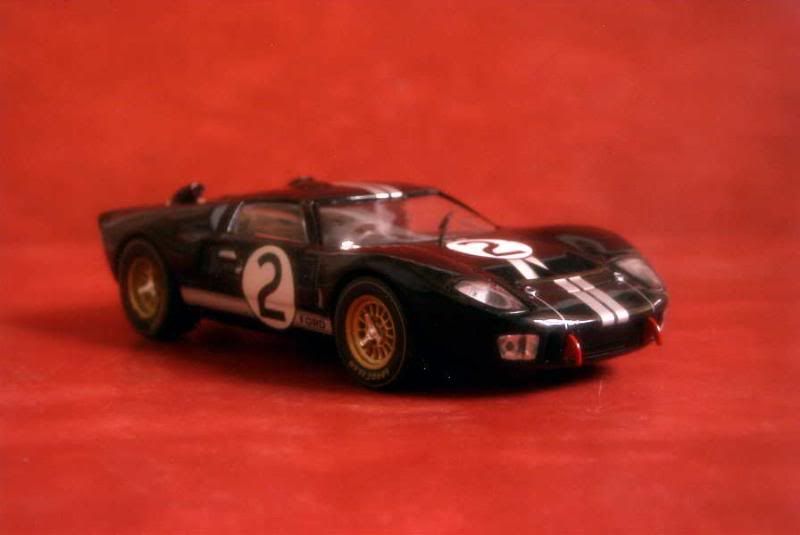
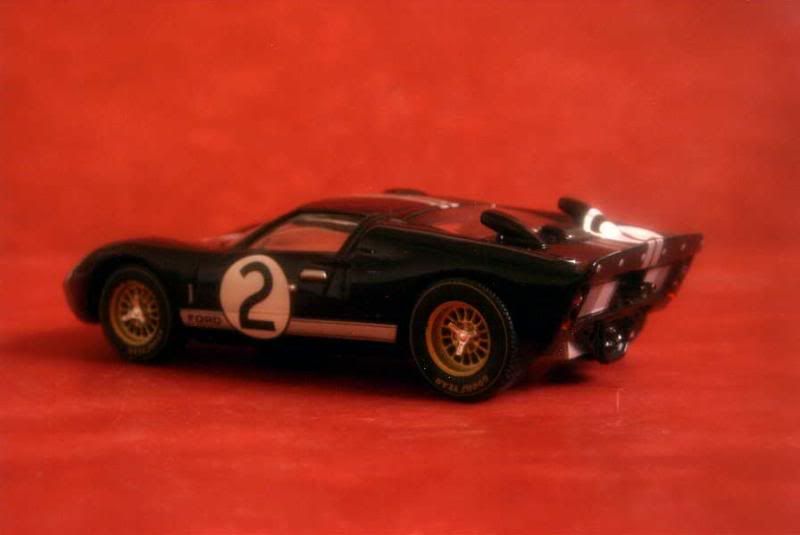
Model: Ford GT40 Mk.II
Event: 1966 Le Mans 24 Hours, driven by Bruce McLaren and Chris Amon (overall winner)
Maker: Ixo
Scale: 1/43
Distributed by: Altaya as no.33 of its Les Plus Belles Voitures des 24 Heures du Mans press series
Acquired: brand new, in February 2005, in Souillac, France

Rather detailed compared to other models within this Altaya series. Nice wheels, too. My rating is 14/20.
Photobucket

Photobucket

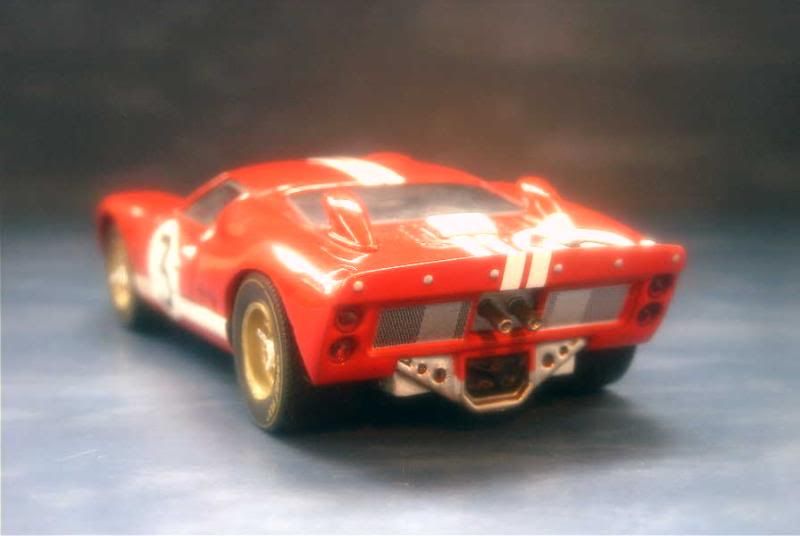
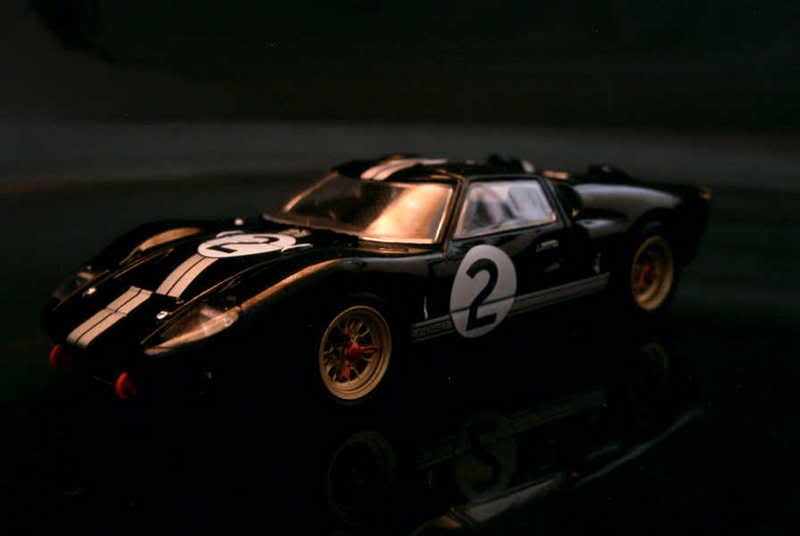
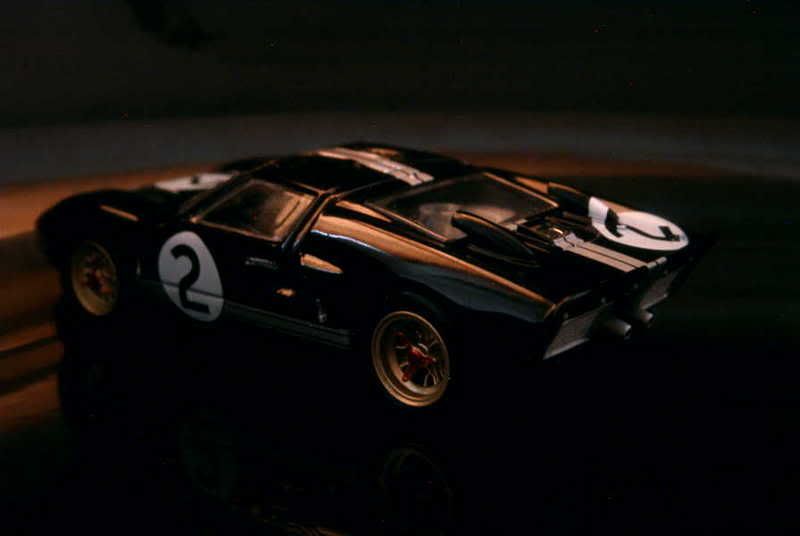
Model: Ford GT40 Mk.II
Event: 1966 Le Mans 24 Hours, driven by Bruce McLaren and Chris Amon (overall winner)
Maker: Del Prado, or whoever builds models for Del Prado
Scale: 1/43
Distributed by: Del Prado through an unknown Japanese press series
Acquired: brand new, in December 2006, in Hong Kong, S.A.R.

This is exactly the same car as the previous one, but this time as seen by Del Prado. Unsurprisingly, overall quality is inferior to the Altaya/Ixo, but it remains quite good compared to other models distributed by the Italian company. My rating is 12/20.
Photobucket

Photobucket

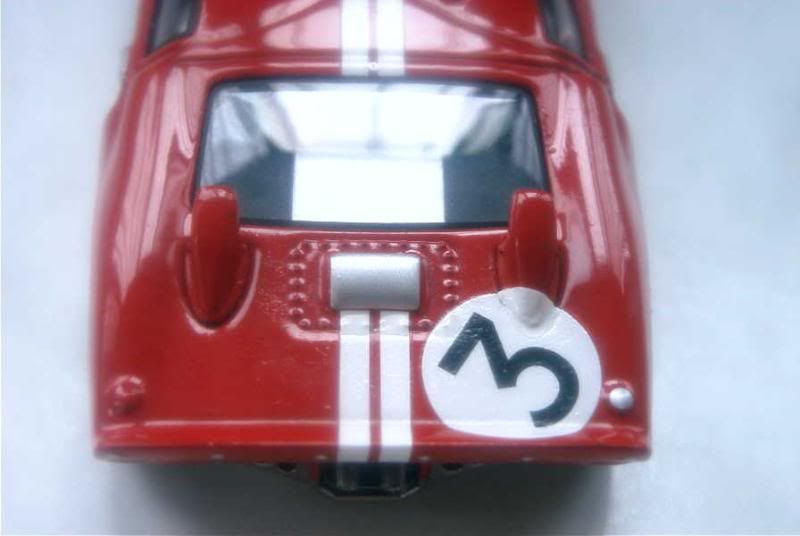
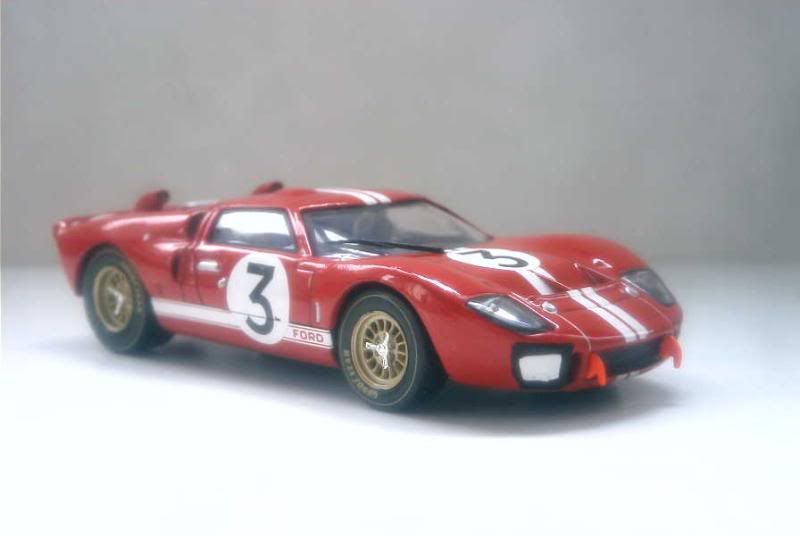
Model: Ford GT40 Mk.II
Event: 1966 Le Mans 24 Hours, driven by Dan Gurney and Jerry Grant (retired)
Maker: Ixo
Scale: 1/43
Distributed by: Altaya as no.5 of its Les monstres sacrés de l'endurance press series
Acquired: brand new, in April 2007, in Souillac, France

Here is a second works Ford from 1966. Though they set the fastest time in practice, Gurney-Grant's radiator forced them to retire. Altaya released this model in a later, more detailed series, so #3 ended up being even better than #2: I'd give 15/20 to it.
Photobucket

Photobucket

Photobucket

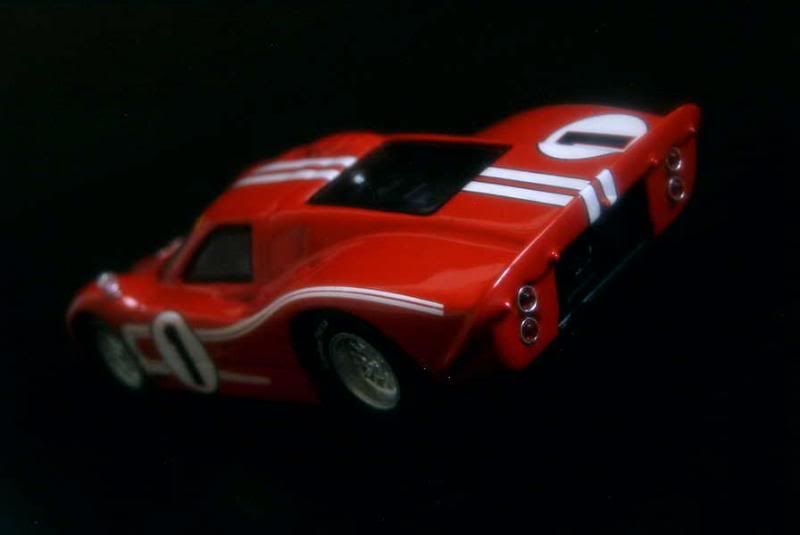
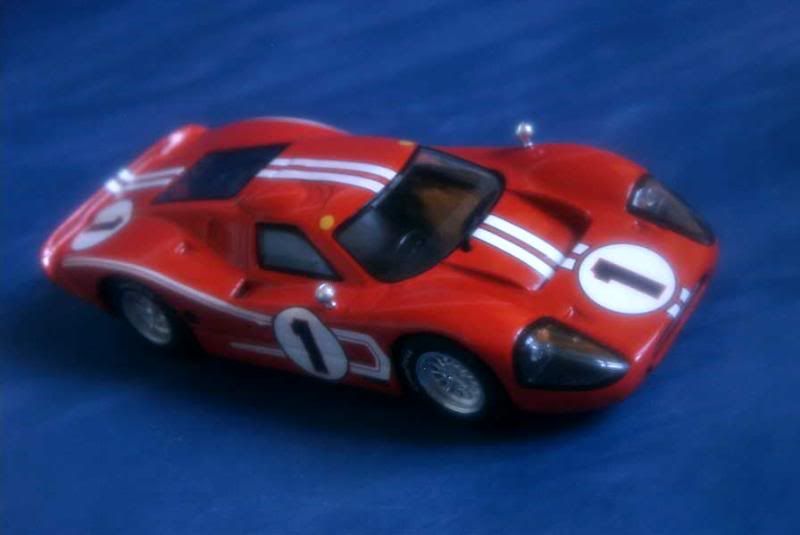
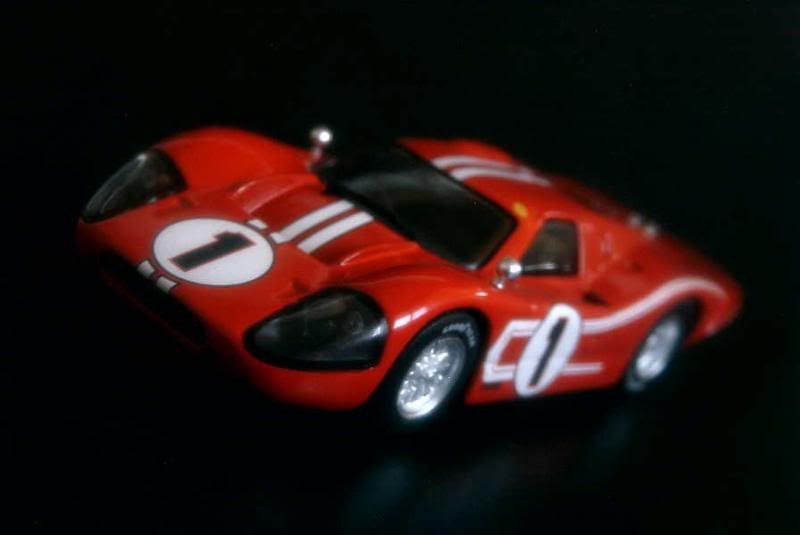
Model: Ford Mk.IV
Event: 1967 Le Mans 24 Hours, driven by Mario Andretti and A.J. Foyt (overall winner)
Maker: Ixo
Scale: 1/43
Distributed by: Altaya as no.23 of its Les Plus Belles Voitures des 24 Heures du Mans press series
Acquired: brand new, in August 2004, in Souillac, France

A nice model of the 1967 Le Mans winner: 13/20.
Photobucket

Photobucket

Photobucket

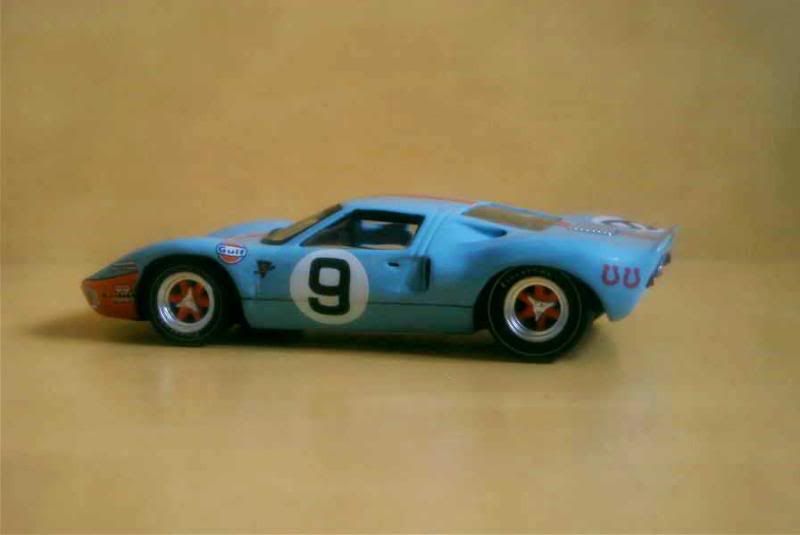
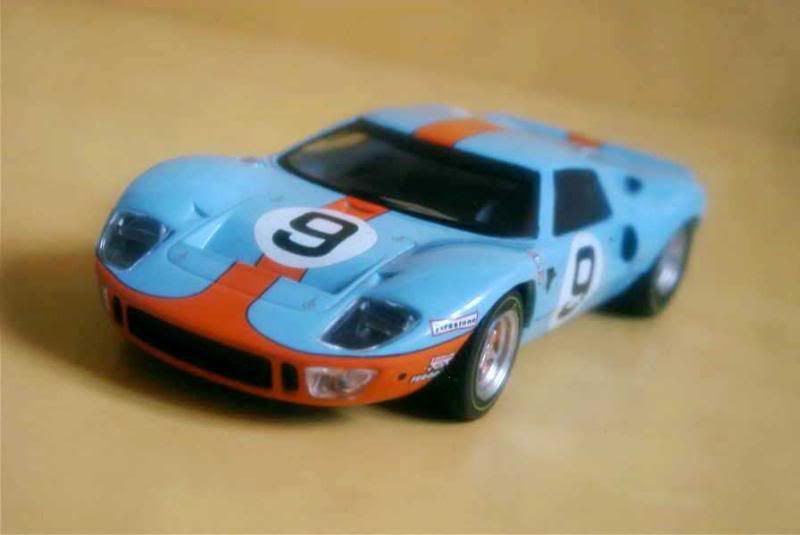
Model: Ford GT40
Event: 1968 Le Mans 24 Hours, driven by Pedro Rodriguez and Lucien Bianchi (overall winner)
Maker: Ixo
Scale: 1/43
Distributed by: Altaya as no.42 of its Les Plus Belles Voitures des 24 Heures du Mans press series
Acquired: brand new, in September 2005, in Souillac, France

Ford's third victory at Le Mans was not the most joyful, as winner Lucien Bianchi learnt on the finishing line that his brother Mauro had been severely injured in the accident and subsequent fire of his Alpine. Another good die-cast by Ixo for Altaya, deserving a 13/20.
Photobucket

Photobucket

Photobucket

Photobucket

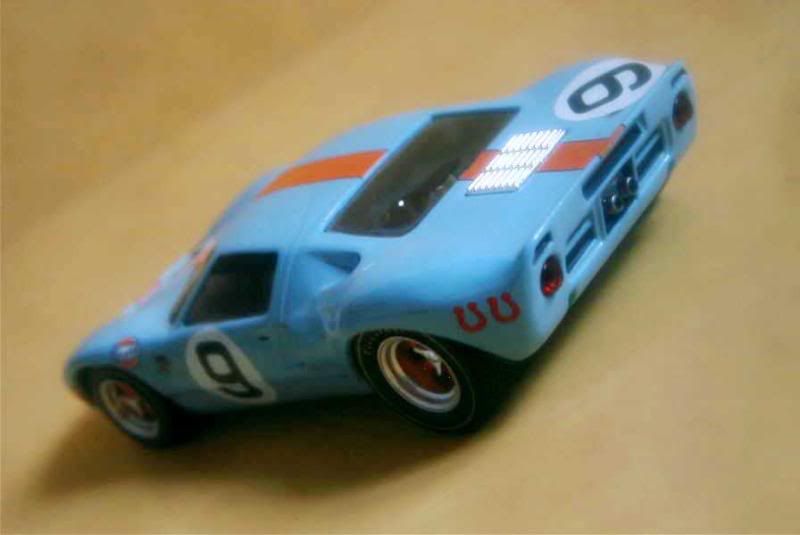
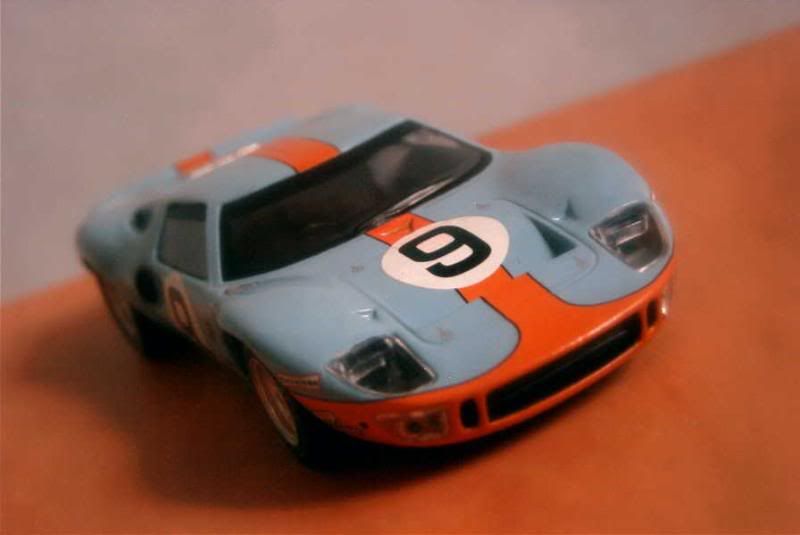
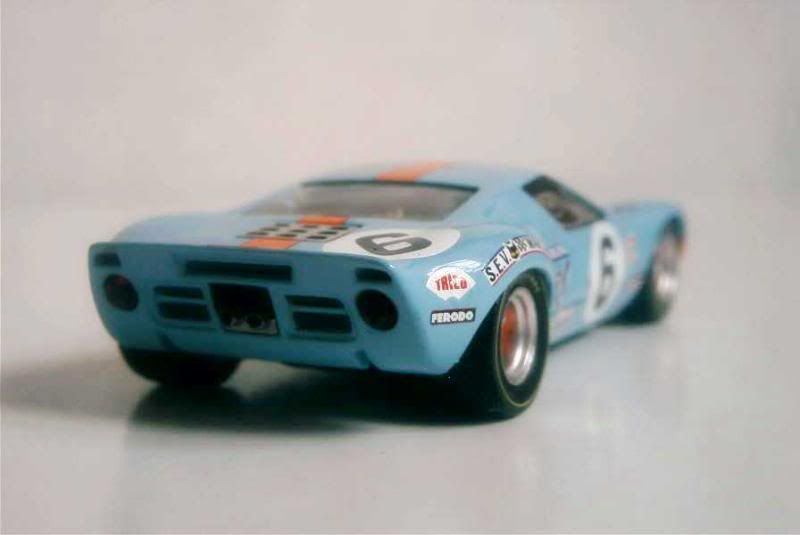
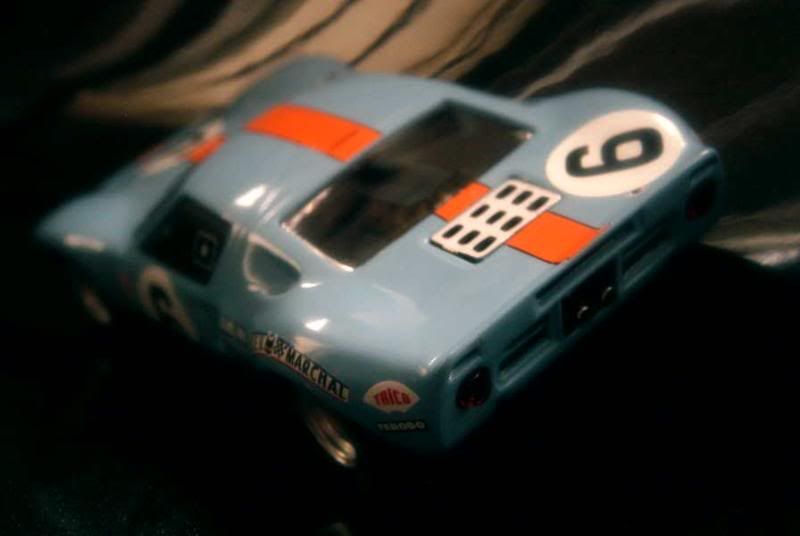
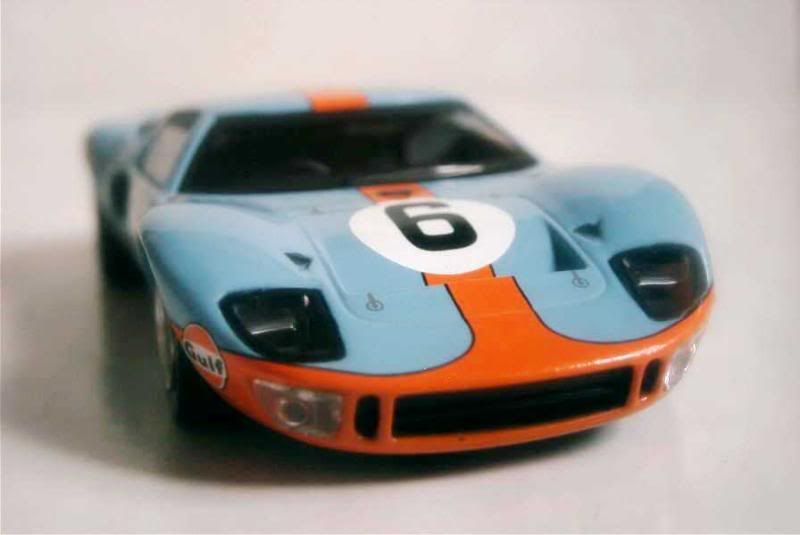
Model: Ford GT40
Event: 1969 Le Mans 24 Hours, driven by Jacky Ickx and Jackie Oliver (overall winner)
Maker: Ixo
Scale: 1/43
Distributed by: Altaya as no.18 of its Les monstres sacrés de l'endurance press series
Acquired: brand new, in May 2007, in Souillac, France

One of the most extraordinary race in the Sarthe: after Ickx started last in protest against the safety flaws induced by the typical Le Mans start, he and Oliver won the race after a final sprint run to the finishing line. This time, the switch to the slightly more refined Monstres sacrés series didn't bring much improvement over the previous car, hence an identical 13/20 rating.
Photobucket

Photobucket

Photobucket

Photobucket

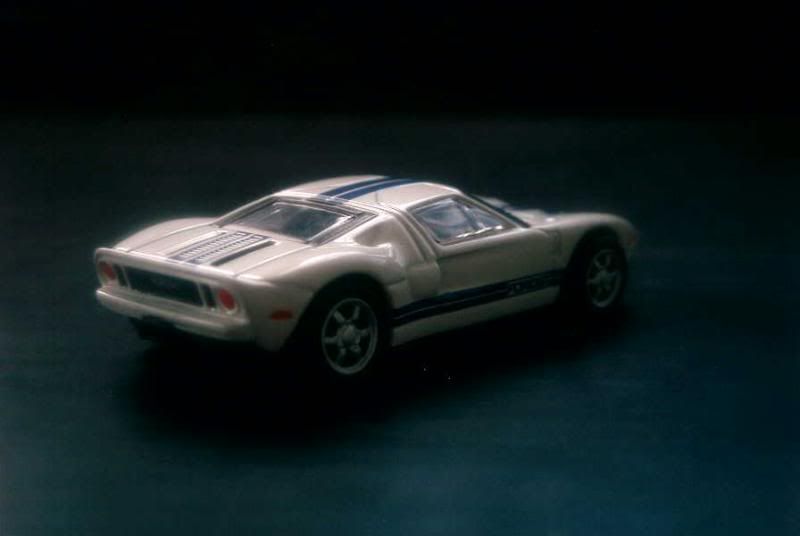
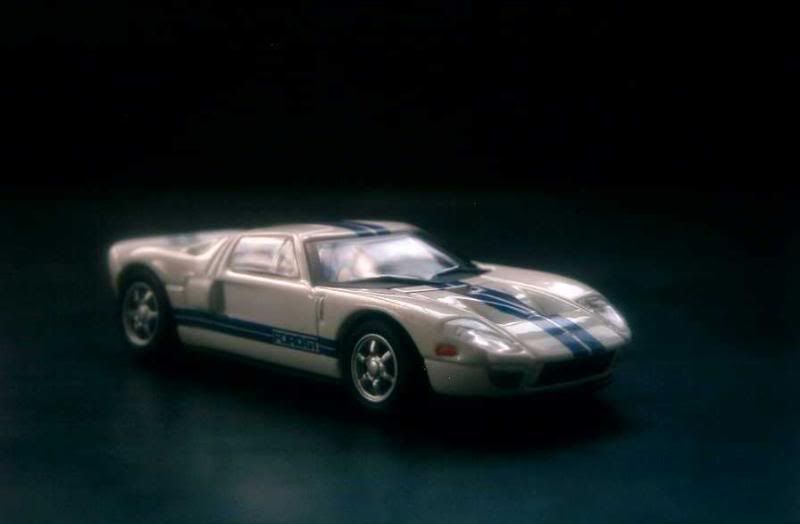
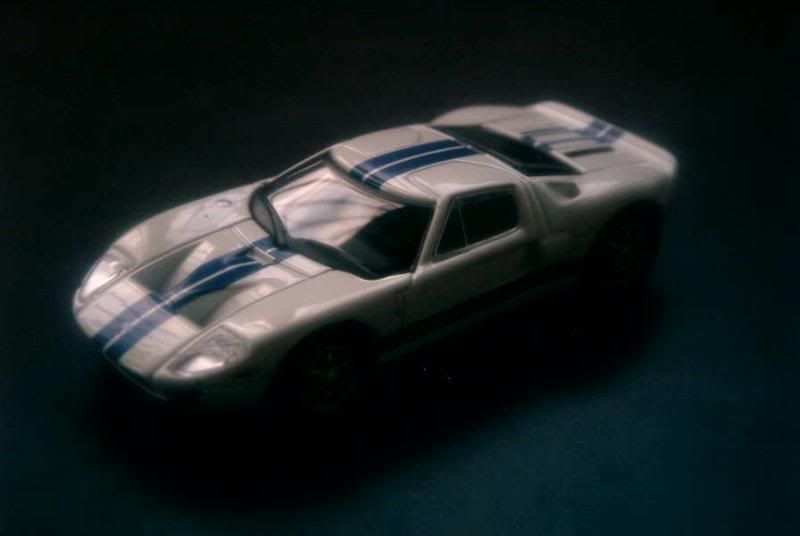
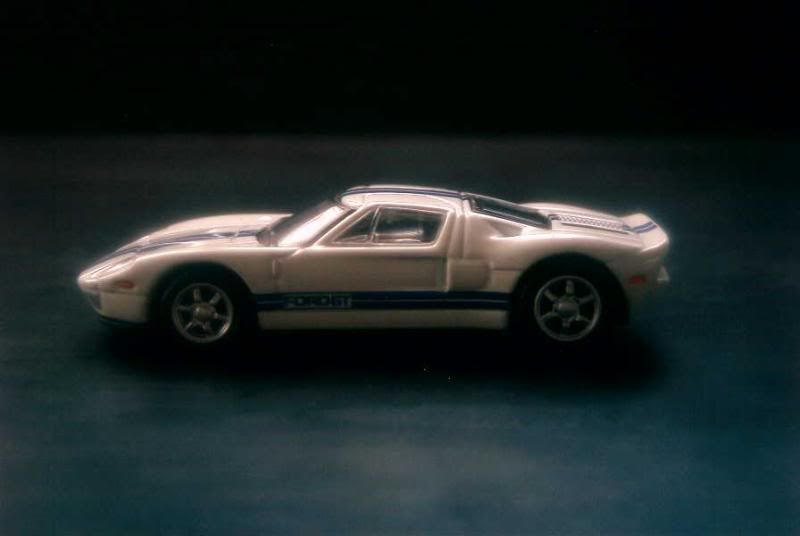
Model: Ford GT
Year: c.2005
Maker: Yat Ming
Scale: 1/72
Distributed by: Road Signature, "Petite" series
Acquired: brand new, in April 2006, in Manila, Philippines

Very correct rendition, despite the small size. My rating is 14/20.
Photobucket

Photobucket

Photobucket

Photobucket

February 23, 2011

No, this blog is not inactive...

...though I can actually look as it is. Last year, during the same season, I had a few months-long lapse, but this year has nothing to do with it.

First of all, while checking one by one all of the previous posts in order to correct the links within the text due to the problems I already mentioned, I noticed that, unlike what I stated earlier, probably 30 to 35% of the answers you had posted on this blog are gone forever. Obviously, this is just a rough estimate, and the exact figure could even be higher. The disappointment this caused me made me stay away from writing anything for the whole of December, but I had plans to resume in January. Alas, during the Christmas season my internet connection just let me down. After shopping for a new company, and waiting long enough to see its employees finally coming home to set my new line, here I am, back on the net since yesterday. My priority now is to answer piles of e-mails which have accumulated in my mailbox over close to two months, and to calm down flocks of friends and relatives who didn't receive their traditional greetings this year but, once this is done, I promise that I'll return with more models and their history, and perhaps even a few surprises.

Before closing this post, allow me to renew with an old tradition by welcoming our two latest followers, ACARtier and Enzo. Enjoy your stay here! ;)

December 05, 2010

Citroën 8 to 15CV “Rosalie”

Welcome to our new followers: Resti, Resti (apparently his twin brother :lol:), Pablo, Rikardo Matos (I like your Michel Vaillant avatar very much), and Conry43 (who makes no mystery of his/her favourite scale). Enjoy your stay here, and don’t hesitate to post comments!

A little history


Citroën replaced its C4/C6 range with a brand new car in 1932. Though officially named – rather plainly – 8, 10 or 15CV, denoting the fiscal ratings of its three variants, the new model was christened “Rosalie” by the public, after a successful Citroën record car of the time. The name is still attached to the range.

Once again Citroën came up with a relatively conventional automobile, but highly rationalized mass-production allowed the company to offer as standard equipment refinements that were unavailable from its main rivals. The Rosalie’s main novelty over its predecessor was its synchromesh gearbox on the two upper gears.

The C4/C6’s engines (1.8-litre four and 2.7-litre six, respectively) were carried over to power the 10 and 15CV, receiving only minor improvements in order to boost outputs through slight RPM increases. On the other hand, the 8CV enjoyed a completely new design, a 1.5-litre four that proposed poor performances, but extremely good reliability, an attractive combination for the cheapest model in the range. After being introduced during the C4/C6’s existence, “floating power”, a Chrysler patent, was also back. This technology allowed to limit the vibrations transmitted to the car’s structure by the engine, by installing the latter on rubber mounts rather than directly bolting it onto the chassis, as the practice had been since the birth of automobiles. Another element favouring superior comfort were the new Pullman seats, offered on all Rosalies.

The car appeared in a wide variety of models and bodies in 1932, but was already modernized by 1934, becoming the NH (for Nouvel Habillage, literally “new dressing”). The most obvious improvement of the NH was its slight streamlining, more fashionable than really efficient. Citroën’s new designer, Flaminio Bertoni, gave a modest slant to the Rosalie’s front grille and windshield. Actually, the biggest improvement was invisible: a brand new independent front suspension through torsion bars.

This new suspension arrangement, though it did a lot to perfect the car’s handling, was paradoxically announcing the coming end of its career, as the system was actually tested for Citroën’s revolutionary automobile, the Traction Avant. Its introduction a few months later should have tolled the knell of the suddenly-wrinkled Rosalie. As it turned out, it didn’t.

Despite being Europe’s largest automobile manufacturer and an apparent success, Citroën was near-bankrupt, ruined by its incessant innovations and the extremely high costs of retooling for each new model – ironically, Citroën’s rivals using much more traditional building techniques than the company’s Ford-inspired methods didn’t have to shoulder such a burden. André Citroën lost control of the factory he had created to Michelin, the tyre manufacturer. Citroën’s new owners were not willing to gamble the company’s future on a single model. Rushed into production, early Traction Avants indeed proved insufficiently developed and troublesome for their not-so-happy owners. Therefore, a reassuring line of Rosalies was kept in Citroën’s range. Though reduced in size, this more traditional offer continued to enjoy a large success until 1938. By then, the Traction Avant had been perfected and its sales were peaking out, so the continuation of its predecessor had become pointless.

About the models

Model: Citroën 8CV “Rosalie”
Year: 1933
Maker: Universal Hobbies
Scale: 1/43
Distributed by: Atlas as no.7 of its Passion Citroën press series
Acquired: brand new, in December 2004, in Souillac, France

Universal Hobbies once again designed a fine model for Atlas’ dedicated series of Citroëns, but unfortunately workmanship is not worthy of this effort. My rating is 10/20.

Photobucket

Photobucket

Model: Citroën C4-8 “Rosalie” 500 kg
Year: 1934
Maker: Universal Hobbies
Scale: 1/43
Distributed by: Atlas as no.36 of its Véhicules postaux d'hier et d'aujourd'hui press series
Acquired: brand new, in July 2006, in Souillac, France

The Rosalie range also included trucks, but they retained the C4 name. Note that a diesel engine was even experimented at the time, though it wasn’t put on sale.

This postal Rosalie is from a different press release, but has to be credited to the same manufacturer and the same distributor as the previous model. Overall quality is better here, so let’s give a 13/20 to this die-cast.

Photobucket

Photobucket

Photobucket

Photobucket

November 06, 2010

Jaguar E-Type

That’s now something as four weeks that I didn’t write anything on this blog. To tell the truth, a post about the E-Type should have followed the last one within the usual three-day delay, but I simply lacked any inspiration for writing it...

A little history

...for what is still to be written about such a mythical car? It probably is the ultimate sports car of the Sixties, a sleek, powerful, glamorous yet relatively affordable roadster. By affordable, I obviously mean that it enjoyed a rather low factory price in its time, keeping in touch with the Jaguar tradition, as it saw since then its value skyrocketing at auctions. And what is marvellous with this car is the fact that, more than any other Jaguar, with its muscular, tastefully curved body, it fully incarnates the animal the Coventry factory took its name from.

Jaguar had to replace its long-running XK series. All what its engineers learned during the Fifties with the C- and D-Type racing cars was put to good use when designing the road-going E-Type. The most noticeable similarity between the Le Mans-winning D-Type and its heir was the rounded bodysides/small track combination, a typical characteristic that was supposed to favour high speeds on long straights. Another heritage was the four-wheel disk brakes system. It had been pioneered in motor racing by Jaguar with its C-Type, and was now made part of its road-going cars’ equipment. Power came from the trusted 3.8-litre DOHC straight six used by the XK150. Available as two equally rakish roadster or fastback coupe, the E-Type was introduced in March 1961.

The car’s career would last for fourteen years, during which it didn’t change much overall, or rather, evolved by constant yet tiny steps. Jaguar tried to improve two aspects of its E-Type: its comfort, which, as with most other British roadsters of the time, wasn’t its main quality; and its performances, in order to stay competitive as younger rivals were seeing light.

More than anywhere else, comfort was crucial on the American market, where the car was widely sold as the XKE. New seats and a fully-synchromesh gearbox solved a few of the limitations of the initial car. Jaguar couldn’t avoid offering an automatic transmission, which was done by 1966. Simultaneously, a 2+2 coupe was added to the strict two-seater offered at first.

Regarding performances, the early E-Type’s 3.8-litre block was replaced by a larger 4.2-litre six as early as 1964. The new engine also addressed a common problem of the first production cars: overheating. Finally, Jaguar was able to squeeze its 5.3-litre V12 under the E-Type’s bonnet in 1971.

More than 38,000 E-Type left the Jaguar factory before the model was discontinued in 1975, in favour of the larger, heavier and somewhat blander XJS. Commercial success was its first goal, and was fully attained. As an iconic automobile, the role played by the E-Type to further enhance Jaguar’s image cannot be measured. On the other hand, the racing career of the E-Type was, unlike that of the XK series, virtually non-existent, except during its very first years when a special “lightweight” version was developed.

About the models

I often said that I prefer to spend my money on scale models of vintage cars rather than modern ones. I should add that among my priorities, I buy die-casts of plain cars rather than classics. For this reason, all of my E-Types are very simple and cheap models – one day perhaps I’ll finally buy a decent model of this great car.

Model: Jaguar E-Type
Year: 1961
Maker: High Speed
Scale: 1/43
Distributed by: High Speed, "Model Collection" series
Acquired: brand new, in May 2005, in Manila, Philippines

High Speed over-simplified its E-Type. The front end suffered most. The rear window has odd proportions in my opinion, while the wire wheels... oh no, better not to even mention them. My rating is 6/20.

Photobucket

Photobucket

Photobucket

Model: Jaguar E-Type
Year: 1961
Maker: High Speed
Scale: 1/87
Distributed by: High Speed, "Model Collection" series
Acquired: brand new, in August 2005, in Manila, Philippines

Obviously, High Speed's approach is less damageable in the smaller HO scale, though the wheels remain unacceptable. I'll increase my rating to 10/20 for this model.

Photobucket

Photobucket

Model: Jaguar E-Type
Year: 1961
Maker: New Ray
Scale: 1/43
Distributed by: New Ray, "Auto Model Kit" series
Acquired: brand new, in September 2003, in Manila, Philippines

To make it short: it's a New Ray, period. My rating is 2/20. "No more?", some of you could ask. Oh no, believe me.

Photobucket

Photobucket

Model: Jaguar E-Type
Year: 1961
Maker: Del Prado, or whoever builds models for Del Prado
Scale: 1/43
Distributed by: Del Prado through an unknown Japanese press series
Acquired: second hand without box but with stand, in April 2006, in Manila, Philippines

...and the winner is...
Only marginally better than the previous models, this Del Prado features more details, and is proportioned correctly enough. Headlights don't receive any cover, though, which was only a trait of the last E-Types built. Wire wheels aren't good (Del Prado definitely has no idea about how to make them, whatever the model) but are still better than the ones of its rivals. Let's give it a 9/20.

Photobucket

Photobucket

October 10, 2010

Mercedes-Benz C111

A little history

If you’re from the same generation as I am, and were already fascinated by cars when you were a kid, then you do remember this impressive orange coupe sporting the famous three-pointed star that appeared in all magazines throughout the Seventies. That’s indeed what it was designed for: to be a showcase of Mercedes-Benz’ know-how. It fulfilled this role splendidly, along with that of test-bed for what were then high technologies.

The C111 was actually the name of more than a single car, but rather of a series of experimental vehicles. The very first model appeared in Frankfurt in September 1969, though it had been submitted to comprehensive tests since April. Its main goal was to experiment a Wankel rotor engine. A three-rotor type rated at 280 hp, this block was unable to demonstrate sufficient capacities, so a C111/II fitted with a centrally-mounted, 370 hp four-rotor engine followed during the spring of 1970, in Geneva. Performances were now astounding, as the car even recorded a reported 290 kph top speed, an impressive figure at the time. Could the car be produced? It was already fitted with such niceties as air conditioning and plush leather seats, while its gullwing doors were a hint at its prestigious ancestor, the 300 SL, so it is possible that Mercedes-Benz considered the possibilities, though it denied it. At any rate, world politics decided otherwise.

Many an automobile maker was then toying with the idea of fitting Wankel engines to their production cars. They were light, compact, simple thus reliable, and could develop high outputs. Their only problem was their huge appetite for gasoline, a flaw that was inherent to their design and thus that no tweaking of any kind could ever solve. But who cared when oil was so cheap and plentiful? The 1973 crisis suddenly broke out to prove otherwise. Oops. Wankel engines were promptly put away in the kind of storage reserved for “brilliant” ideas that had proved not so good after all, being promised to re-enter the limelight at a time that, in all likelihood, would never come. To be frank, we escaped the worse as Wankel engines were also polluting in proportions that today would make any conventionally-powered gas-guzzler of that carefree era appear eco-friendly. Only three manufacturers, then more advanced in their experiments, put Wankel-powered cars in production: NSU, Mazda and Citroën. This generally ended up with more tears than mirth.

The experimental fibreglass coupe from Mercedes-Benz didn’t disappear, though a completely different approach was needed. After a short eclipse, its Wankel engine was discarded, and replaced by the 3.0-litre five-cylinder diesel block that was in use in several production models, first of all the 240 D 3.0. Economy was the new talk of the town, but Mercedes-Benz wanted to demonstrate that it wasn’t incompatible with performance. Thanks to a turbocharger and an intercooler, the C111/IID could reach a remarkable 190-hp output. In June 1976, the car resurfaced in its newest form on the Nardo track, where it broke sixteen world records over two days and a half. During these tests, the C111/IID also lapped the circuit at 252 kph.

The C111/IID’s successes pushed Mercedes-Benz to develop yet another prototype, the C111/III. Gone were the production-like coupe approach of the previous models, the new car was designed from the ground up for records. In April 1978, the very sleek car was again sent to Nardo, where nine records were broken – no longer records for diesel-powered cars, but absolute ones. Average speeds of more than 300 kph were maintained, though fuel consumption didn’t exceed 16 litres per 100 kilometres. The only problem encountered was the explosion of a tyre at high speed, which damaged the car beyond repair – but fortunately a spare car had been brought, so the run was simply started anew.

A last record tempted Mercedes-Benz. It was unofficial, but highly prestigious. In 1975, a Can-Am car had set the fastest average speed on one circuit lap, at 355.854 kph. A new C111/IV was especially prepared to tackle this last challenge. The Mercedes-Benz team returned to Nardo in 1979. On May 5, project manager Dr. Hans Liebold lapped the track at an astounding 403.978 kph. Besides, the car broke a few more records. Then, time had come for all the C111 to head for the museum.

About the model

Model: Mercedes-Benz C111/II
Year: 1970
Maker: Minichamps
Scale: 1/43
Distributed by: Minichamps ref. 430-030060, limited edition - 1,440 pieces
Acquired: second hand with box, as a gift from a friend and fellow collector, in August 2010, in Manila, Philippines

That’s a splendid scale model of arguably the most famous of all C111s that Minichamps produces. Though I’m not fond of opening parts for 1/43 models, the German company perfectly adjusted the rear hatch, which discloses the unconventional Wankel engine. All details near perfection, while the model is finished in a superb orange paint, close to the weissherbst of the original. My rating is 17/20.

Photobucket

Photobucket

Photobucket

Photobucket

Photobucket

Photobucket

Photobucket

Photobucket

Photobucket

Photobucket