April 22, 2009

Citroën AX

A little history

In 1986, the Citroën AX was given the task of succeeding both the two-door LNA and the four-door Visa. Traditional engines were totally abandoned as all air-cooled flat twins were now discarded, the AX receiving only orthodox inline fours. On the outside, the new Citroën was quite an attractive car and, back then, a modern-looking one. The combination of a light weight, thanks to the extensive use of plastics, and of very good aerodynamics allowed the AX to be an excellent performer, as well as a rather economical vehicle: in 1989, a thousand-mile trip on open roads by a diesel-powered AX was achieved with a still exceptional fuel consumption of 2.7 litres per 100 kilometres, making Citroën's little car the world's most fuel-efficient production automobile of its time.

The Citroën AX remained competitive on the market throughout most of its career. When its replacement, the Saxo, was finally launched in 1996, the AX didn’t even bow out and was maintained for two more years in Citroën’s catalogue.

(This car’s history will be expanded in due time, please be patient.)

About the model

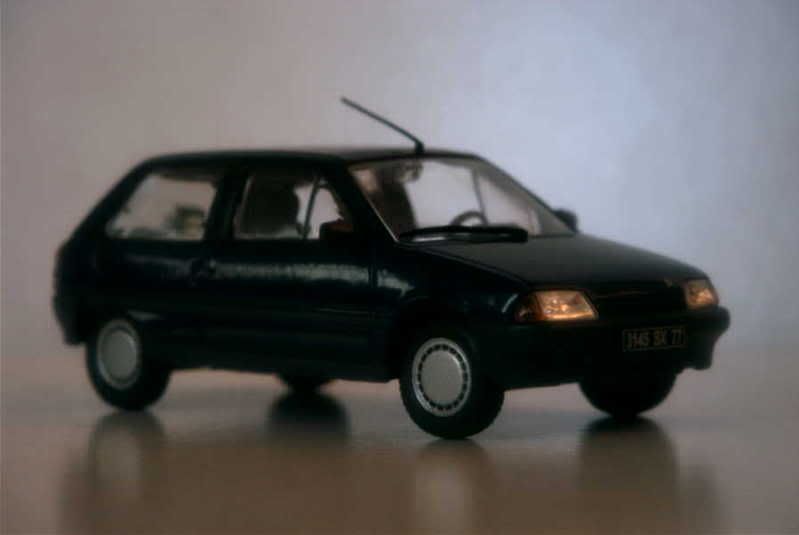
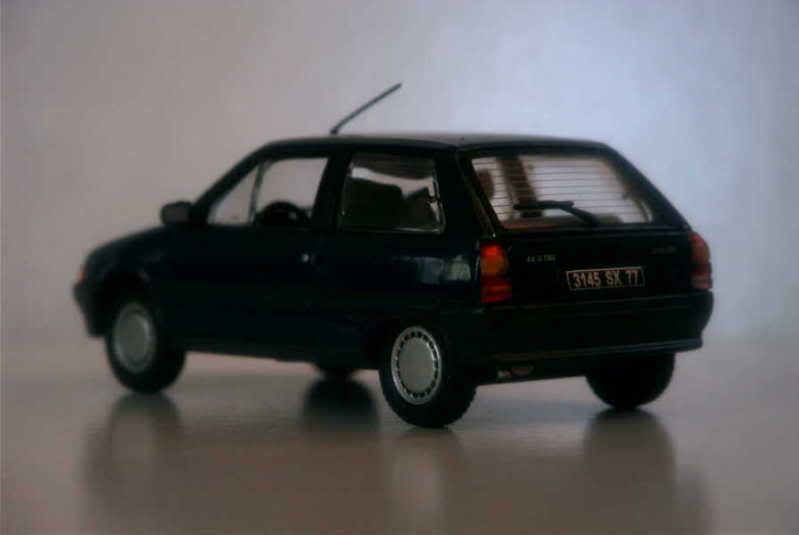
Model: Citroën AX 11 TRE
Year: 1987
Maker: Ixo
Scale: 1/43
Distributed by: Altaya as no.91 of its Nos Chères Voitures d'Antan press series
Acquired: brand new, in October 2007, in Souillac, France

This is one of the last models to appear in Altaya’s Voitures d’Antan series and although it is outside the time frame initially set when this collection was launched, at least it is not a foreign automobile seldom seen on French roads, if ever. These last models are often characterized by a higher level of detailing – Ixo has made a particular effort about the lights, and most notably the rear ones which were over-simplified in the early die-casts provided to Altaya, unfortunately compromising their level of realism. This AX benefited from such a welcomed evolution, and as a result is probably one of best models of the series, though the choice of a very dark blue paint has the regrettable effect of making much harder the perception of some of the body’s details. I’d give 13/20 to this car.
Photobucket

Photobucket

BMW 501 and 502

A little history

The first automobile built by BMW had been a licensed Austin Seven, but the Bavarian firm soon graduated to bigger and better automobiles with a sporting twist. Alas, World War Two came soon thereafter. The automotive activities of the company, still deeply involved in aeronautics, were concentrated on two plants: Munich in the West, and Eisenach in the East. While the Munich factory was flatten by Allied air raids, the Eastern one was left untouched, being out of reach for airplanes based in England while the Soviet lacked strategic bombing capacities.

By May 1945, East Germany had fallen into the hands of the Red Army, and soon the Eisenach factory independently resumed the production of a few pre-war models. Many were exported, to (Western) BMW’s dismay: quality was much lower than that of pre-war products, and the Bavarian company was concerned about its spotless image being soiled. As a result the Eastern branch was renamed EMW and new emblems, similar in design to the old ones but with a green colour replacing the traditional blue, were fitted to the cars already produced. Divorce was complete, and BMW was left without any capacity to resume its own activities. The post-war period couldn’t begin more inauspiciously.

BMW’s automobile construction was painfully restarted in October 1952 with a brand new model, the 501 introduced at the previous year's Frankfurt auto show. The new car’s peculiar styling is perfectly resumed by its nickname “baroque angel”: it certainly wasn’t some kind of monstrosity, but still looked somewhat odd to say the least. Ancient (the separate front and rear wings) and new (the large glass areas) styling cues cohabitated rather ungainly but, most important of all, BMW finally had something to sell.

Less surprises awaited a BMW customer beneath the strange skin, as the power still came from the well known 2.0-litre six. Though considered brilliant before the war, this engine had a hard time setting in motion such a heavy car as the 501. BMW addressed the complaints about its model’s weak performances by introducing a new 502 variant in 1954. Under the bonnet, the inline six was replaced by a more potent 2.6-litre V8 good for 100 bhp. Few other details differentiated the 502 from the 501: slightly more luxurious appointments inside the passenger compartment, and a little more brightwork including an ostentatious “V8” badge on the boot lid.

If the 501 was offered as a saloon only, the prestigious 502 attracted the attention of coachbuilder Bauer, which was a major BMW partner since the Thirties and still remains as such today. The Stuttgart workshop put on sale an attractive two-door drophead version of the 502 almost as soon as the saloon was introduced, then an equally glamorous coupe during the following year. Two exclusive sportscars, the 503 and the 507 designed around the 502’s V8, were also added to BMW's range in 1955.

The launch of the new 503/507 duet exemplifies better than words the questionable choices made by BMW management during the Fifties. The sales of the 501 and 502 saloons remained low, and no replacement was scheduled. Large amounts of valuable resources were spent studying two sportscars built in even smaller quantities, and for an even shorter period of time: between 1956 and 1959, only 413 ‘503’ and 252 ‘507’ were sold, each of them in exchange for a little fortune. They certainly did a lot for BMW’s image, but not for its floundering finances. To save itself from bankruptcy, BMW made a radical choice by producing a small popular vehicle. Having no experience in this field, BMW opted not to design its own car but instead to produce someone else’s creation under license. The chosen car, the tiny Isetta, saved the struggling company. This allowed BMW to maintain its 501/502 range in production until as late as 1964, by what time these cars definitely looked antiquated. Despite their long production run, less than 15,000 of those were ever built, and their maker saw no urgency in replacing them – actually, the company waited until 1968 to introduce its modern 2500 and 2800 saloons.

About the models

Model: BMW 502
Year: 1954
Maker: Minichamps
Scale: 1/43
Distributed by: Minichamps ref. 430-022405, limited edition - 1,008 pieces
Acquired: brand new, in February 2006, in Manila, Philippines

Not surprisingly Minichamps tackled the reproduction of this bit of German automotive history. It has been done with the usual quality this company is known for. Minichamps’ biggest mistake about this car is actually on the box, which describes the car as a 1953 model – considering the fact that the 502 was announced at Geneva in March 1954, and put on sale in July of the same year, Minichamps’ assertion appears all the more improbable. My rating is 14/20.

Photobucket

Photobucket

Photobucket

Photobucket

Model:
BMW 502
Year: 1959
Maker: Detail Cars
Scale: 1/43
Distributed by: Detail Cars, "Platinum" series ref. 242
Acquired: brand new, in June 2005, in Manila, Philippines

Bauer’s convertible version of the 502 was made by Detail Cars. Minutiae are arguably a little less fine than those of Minichamps in some places, but better executed in some others. Overall the two die-casts are quite similar, eliminating the recurrent collector’s problem of putting side-by-side on the shelf identical cars of which two different die-casts makers had divergent visions. As it was often the case with the regretted Italian company, design is good but quality of workmanship can be very different from one model to another, so if you’re lucky enough to find brand new 502s that have remained unsold up to now (I was, but I seriously doubt that it’s still possible today), examine yours with care before taking the decision to buy. A last remark: the wing-mounted rear view mirror is extremely fragile, so always manipulate this model with extreme precaution. Uneven finishing touches limits my rating to 13/20, but well assembled models are certainly as good as the Minichamps above, if not better.

Photobucket

Photobucket

Model: BMW 502
Year: 1959
Maker: Detail Cars
Scale: 1/43
Distributed by: Detail Cars, "Platinum" series ref. 241
Acquired: brand new, in June 2005, in Manila, Philippines

The coupe is again a Detail Cars model. I ignore why the Italian brand fitted its convertible with only one external mirror while the closed car has two, but with regard to what I wrote above it surely gives collectors double the trouble. The same remarks as those about the convertible version apply here, so I’ll again give a 13/20.

Photobucket

Photobucket

Iso Isetta

A little history

Lamborghini made tractors before starting the production of its very first GT; as for itself Iso initially built refrigerators but didn’t graduate directly to Gran Turismo, passing through different stages instead, during which the Milanese company produced mopeds, then a popular four-wheel vehicle, the Isetta.

At first sight, the Isetta, a wheeled bubble that looked like nothing else on the road with its lone front door, could appear as a failure as it enjoyed a very limited production run in Italy: only a thousand built between the end of 1953 and 1955. However the diminutive Isetta, seating only two and devoid of differential – hence its very narrow rear gauge –, encountered a much more brilliant success outside the peninsula’s borders. Iso installed production lines in Spain, Belgium and Great Britain, and granted a license to Brazilian firm Romi. Slightly modified, the car was also built near Paris by Velam, but its main producer was to be the German company BMW. Nearly bankrupt owing to its unyielding battle with Mercedes-Benz for the control of the narrow luxury car market, the Bavarian firm was saved by the Isetta, produced at first in a virtually identical version which was progressively enhanced. The largest BMW model, the 600, was a stretched Isetta seating four. The last of the Isettas were built in 1962, when production of both the German and British versions of the car was stopped.

(This car’s history will be expanded in due time, please be patient.)

About the model

Model: Iso Isetta
Year: 1955
Maker: Ixo
Scale: 1/43
Distributed by: Altaya as no.75 of its Nos Chères Voitures d'Antan press series
Acquired: brand new, in April 2007, in Souillac, France

A nice model overall, this Isetta is nonetheless another lazy attempt by Altaya to maintain its Voitures d’Antan series alive for as long as possible – see what has already been said about the Ford Anglia to get the whole picture. Again the Isetta made sense among the original Spanish collection, but is totally meaningless after it travelled across the Pyrenees. To fulfil its promise Altaya would have done well by distributing a scale model of the Velam in France, but the simple change of headlights – they were separated from the body on the French version of the Isetta – required (minor) modifications to the mould and as a consequence induced costs that the Spanish distributor simply refused to bear. Well, there are many reasons for the relative low cost of the press series versus genuine Ixo models, and the sacrifice by its customers of Altaya’s respect towards them seems to be one of those. Strictly focussing on this model’s intrinsic qualities, I’ll penalize it for nothing else than bearing an irrational Parisian registration and still award it a decent 11/20.

Photobucket

Photobucket

Photobucket

April 21, 2009

Chevrolet Captiva

A little history

Taking design cues from the S3X concept car presented by parent company Chevrolet, built on an extended version of the Saturn Vue’s platform, the Daewoo Windstorm appeared in 2006 as a 2007 model. General Motors’ strategy since its takeover of the South Korean company having been to limit the use of this brand to its native country, even if this SUV is widely exported it bears the name Chevrolet Captiva in most of the world, with the exception of Australasia where the car is rebadged as a Holden Captiva. A pretty large vehicle graced by a rather pleasant styling, the Windstorm/Captiva is powered by a 2.0-litre turbocharged diesel, a 2.4-litre four or a 3.2-litre V6.

(This car’s history will be expanded in due time, please be patient.)

About the model

Model: Chevrolet Captiva
Year: 2006
Maker: Norev
Scale: 1/43
Distributed by: Norev
Acquired: new with neither box nor stand (probably a production overrun or quality control reject), in January 2007, in Hong Kong, S.A.R.

Facing the choice of buying either the model of a vintage automobile or that of a brand new car, I’ll always go for the older one. Nevertheless no rule goes without exception and on the date I bought this Captiva there could have hardly been a newer model. My decision probably has something to do with the quality and care for details that Norev displayed to reproduce this SUV. There isn’t much complaints I could make so I’ll give this die-cast a 15/20.

Photobucket

Photobucket

April 20, 2009

Announcement: An Update

On April 18, I posted a little article about the Prince Bluebird and Gloria, featuring pictures of the latter car that were said to be only temporary as their quality was rather poor. Most have now been replaced by better ones so feel free to have a second look at them.

Sunbeam Alpine and Tiger

A little history

The first Alpine had only been launched in 1953, but only a few years later it was obvious that its design was prematurely ageing. The Rootes group promptly decided to plan a fresh new car, still bearing the same name and using as many existing mechanical parts as possible, but with a brand new body. Though many sources declare that its main designer Kenneth Howes took its inspiration from the recently released Ford Thunderbird, it has to be noted that the second-generation Alpine actually bore a striking resemblance to the convertibles designed and built by Facel-Metallon, particularly for Simca.

Launched in 1959, the car passed through five different series before retiring in 1968. All remained basically similar to the original car, though the 1.5-litre block was enlarged to 1.6- then to 1.7-litre. These engines made the car an elegant tourer, but not a performance machine. Widely distributed in America, the Alpine’s performances looked even more limited there. Therefore it was decided to produce a V8 variant of the car at the lowest possible cost. With some logic, Carroll Shelby, who had already led a comparable transformation based on another British car, A.C.’s roadster, was chosen for the task. Shelby fitted a 4.3-litre Ford developing 164 hp under the Alpine’s hood, which became the pumped up Tiger, introduced in 1964. Output was exactly double than a standard Alpine of the time, which was rated at 82 hp. Later the original V8 was replaced by a bigger 4.7-litre good for 200 hp. Even with this latter engine the Tiger had nothing in common with the similarly created A.C. Cobra, but it nonetheless offered decent acceleration. In 1967, the Tiger was withdrawn somewhat earlier than the Alpine, not due to lack of interest from the public, but rather as Chrysler had just purchased Rootes and couldn’t stand that one of its products could use an engine built by one of its main rivals.

The Sunbeam Alpine never got a real successor, though the name was used a few years further for a simplified version of the Rapier coupe, a good-looking but underpowered car that was built until the mid-Seventies.

About the model

Model: Sunbeam Alpine Mk.II
Year: 1961
Maker: Vanguards - Corgi
Scale: 1/43
Distributed by: Vanguards
Acquired: brand new, in January 2007, in Hong Kong, S.A.R.

Vanguards again did a decent job reproducing the classic lines of the Alpine. The wheels are probably oversimplified, but overall this reproduction is correct. Moreover the British company had the good idea of providing three different tops for the car (which nonetheless have to stand perched on the car, without anything to hold them firmly in place): a folded hood, a raised hood and a hard top. I’d give 12/20 to this nice model.

Photobucket

Photobucket

Photobucket