October 29, 2011

Maserati A6 road cars

Welcome to juanh, for whom I had in mind to make a Formula One post today... but I completely forgot about my initial plan, so here is something quite different.

A little history


Though its road cars are probably more renown today than its racing cars are, Maserati basically remained focused on competition for the first four decades of its history. Even if this dramatically changed after the introduction of the 3500GT in 1957, some road cars, closely related to the machines raced by the little factory, had already been produced in very small numbers since the end World War Two. This all started with the A6/1500, a small 1.5-litre car usually bodied by Pinin Farina. Though its six-cylinder engine was based on the machinery of the pre-war Maserati single-seaters, its power was down to a modest 65 hp, mostly due to the mandatory low-grade gasoline that was available – hardly easily, still – in the country at that time. Following its introduction at the 1947 Geneva motor show, the A6/1500 was produced in sixty-one copies until 1950, when the company seemed to distance itself from road-going automobiles to concentrate again on racing cars. This situation didn’t last and, at the Turin motor show in 1951, Maserati presented the A6G, based on the A6’s chassis, but fitted with a 100-hp 2-liter engine again based on a racing block. Unfortunately, the A6G’s design was too much dated and its engine still too modest despite its larger displacement to compete with Ferrari’s models, resulting in abysmal sales – no more than sixteen A6G were produced until 1954. For the anecdote, a Maserati light truck, the 550 cc or electrically-powered TM15, was also introduced at Turin in 1951 and didn’t really fare better, with only fifty-one being built until 1956 when the utility market was abandoned without regrets.

With its placid engine but excellent tubular chassis, the A6 soldiered on for a few more years. The A6G was succeeded at the 1954 Paris motor show by the more potent 150-hp A6G/2000. Just before this, five copies of the A6GCS/53 sportscar had been converted to a 170-hp Gran Turismo coupe fitted with a muscular Pinin Farina body, but these were the result of a private initiative rather than a venture from the factory. The A6G/2000 gave way to the much more ambitious Maserati 3500 GT in 1957, by which time its production number had reached the staggering figure of sixty...

About the model

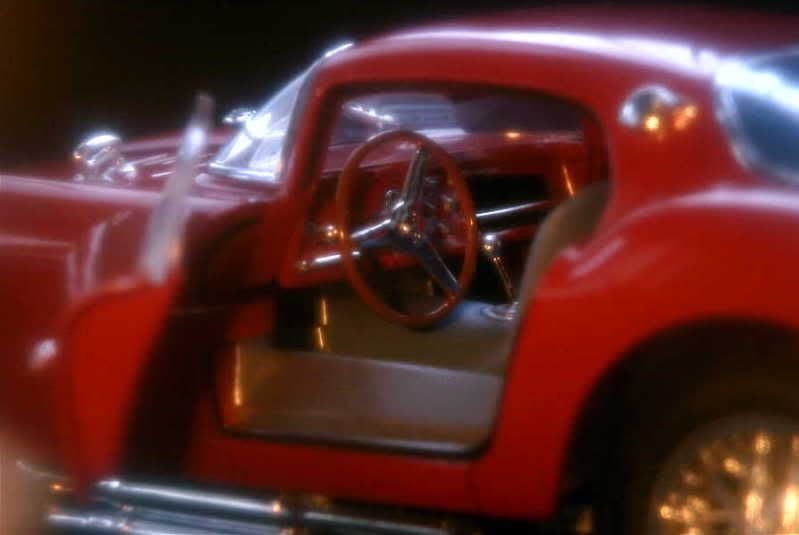
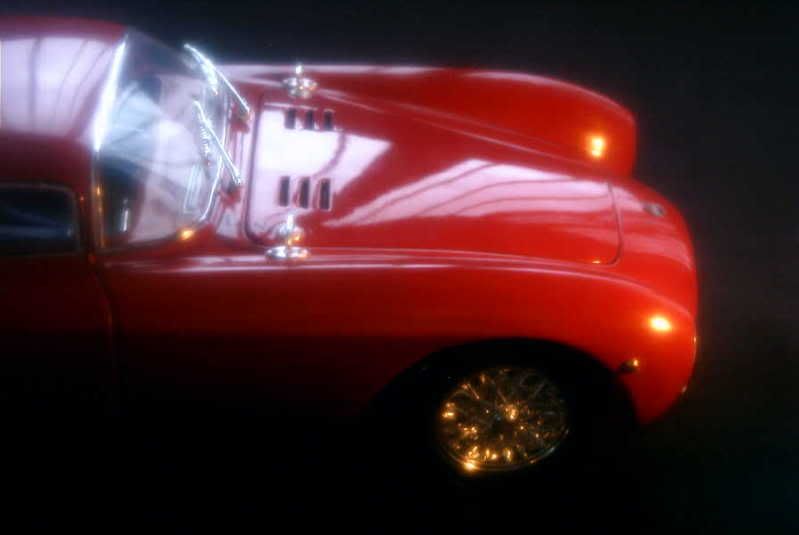
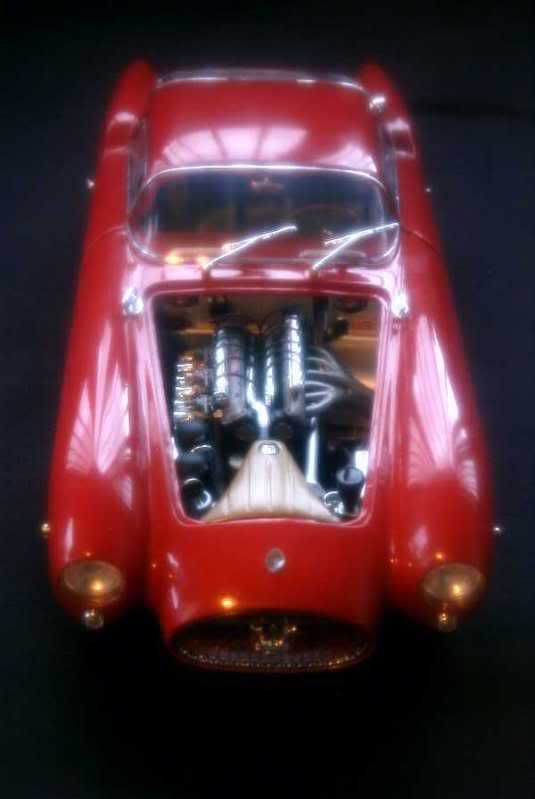
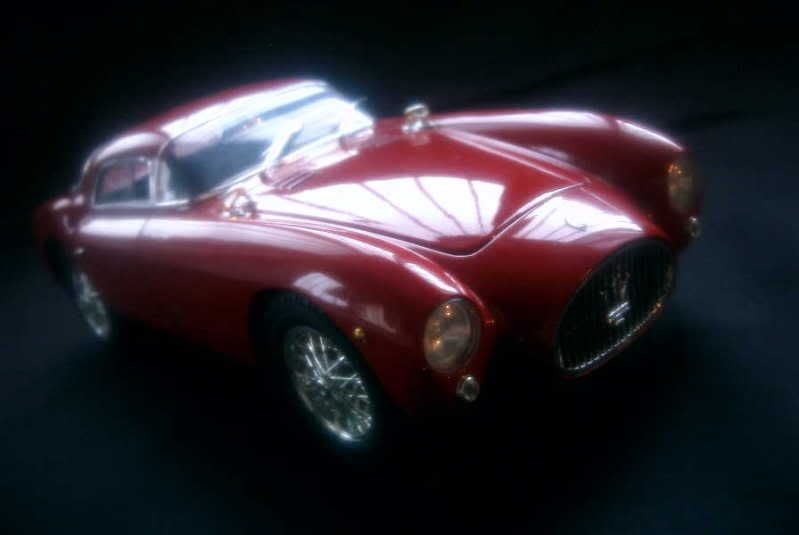
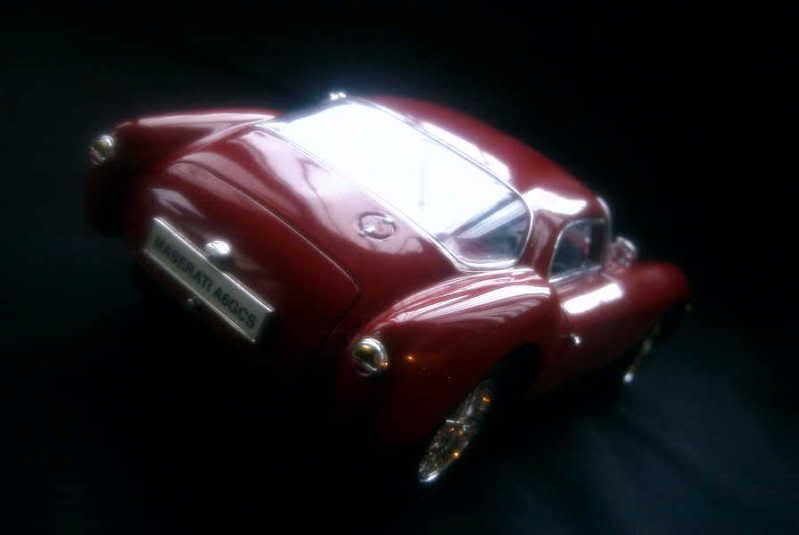
Model: Maserati A6GCS/53 Berlinetta
Year: 1954
Maker: Ricko Ricko
Scale: 1/18
Distributed by: Ricko Ricko ref. 32151
Acquired: brand new, in March 2006, in Manila, Philippines

Ricko has tastefully reproduced one of the four coupes Pinin Farina built out of the A6GCS for Maserati’s dealer in Rome and occasional racing driver, Guglielmo Dei. My point of view is certainly debatable, but I’d like to think this is one of the most striking car ever penned by the famous Italian coachbuilder, allying in equal proportion feline beauty and brutal strength. The die-cast model is well worthy of the original, and deserves a good 14/20 rating.
Photobucket

Photobucket

Photobucket

Photobucket

Photobucket

October 20, 2011

Auburn Speedster

So I’ve been silent during the last eight weeks, except when answering the numerous – yet always clever – messages of our new follower Gaucho Man. Persistent problems with my computer(s) got the upper hand on my good habit of writing a new post every Saturday. Laziness soon settled in afterwards. In addition to this, my trusted old camera asked for a well-deserved retirement. As of now I still don’t know if it can be repaired, but fortunately I have pictures left for a few more posts.

Now for the good news: unlike previously announced, ALL of your comments that had disappeared are now back. Where were they then? Well, er… they were here all the time, actually. When Blogspot added its new “spam” feature, about one-third of all the comments, though already approved, were randomly removed from this blog and placed without any warning into the spam folder… which I never had a look at.

So, to end a long period of silence, I chose an exceptional automobile today. But before we start, as per tradition, welcome Gaucho Man (I can only advise you all to visit his own, very nice blog!) and Tunning66 (interesting blog too).

A little history

Auburn was just one among the dozens of minor automobile manufacturers that had spread across America and were lucky enough to somehow remain in business for some reasonable amount of time. From its founding in 1909 in the small Indiana town after which it was named, the existence of the little company was essentially a tale of survival. Fifteen years later, amid a dire recession that struck hard at the American car industry, Auburn seemed to have met the end of the road.

That was at this exact time that a saviour entered the scene, in the improbable guise of a twenty-nine-year-old man. His name was Errett Lobban Cord. The young folk boasted that he had already twice made a fortune worth a million dollars – and lost it in both occasions. Now he had the opportunity to succeed a third time, and have his name written in all automobile history books in the process.

When Cord was offered to manage the company by its Chicagoan owners, Auburn’s coffers were as empty as its factory was full of unsold cars. The daring young man struck a deal which would actually give him control of the company if he could save it – it took only four years until, by 1928, Auburn became his. How did he succeed? By considering styling an important factor in the power of attraction a car can have towards its potential customers. Though it seems commonplace today, styling was virtually non-existent back then. Cord’s genius resided in a very simple idea: to repaint all the unsold cars with a striking two-tone paint job – all soon found owners. Thanks to this fresh input of cash, Auburn was ready to introduce new models and, once again, styling would be seriously considered. Though a complete range was made available, it was the Boattail Speedster, also launched in 1928, that caught most of the attention – so much that this particular model seems to typify Auburn as a whole. Production increased dramatically, allowing E.L. Cord to form a new Cord Corporation in 1929 in order to manage the many companies he now controlled. For Auburn was just one among one hundred and fifty concerns he owned by then! Checker, the well-known taxi builder, was another one. And so was Duesenberg, which would acquire immense prestige as a luxury brand under the Cord Corporation’s guidance. And obviously, technologically advanced automobiles would also be built under Cord’s name. Most engines were provided by Lycoming, another member of the group. Indeed, its activities extended well beyond automobile to cover all forms of transportation, including a shipyard and several aviation-related concerns (among the latter was the future American Airlines). Alas, though many they were, most of these companies were of too limited a size to survive in a highly competitive environment. And a few months after the Cord Corporation had been formed, the Wall Street crash announced renewed hardship.

Auburn was the “volume” car manufacturer among the company – that is to say that all the automobiles Cord produced were rather exclusive. Sales were plummeting, though E.L. Cord and his team made them more attractive than ever. Tastefully penned, well appointed, fitted with powerful eight or even twelve-cylinder engines (the company advertised its models as the only V12s below $1000) the Auburns of this era are the best remembered nowadays – but still, they didn’t sell well in these difficult times. The most extraordinary of all would appear shortly before the final collapse of the group: it was the 1935 Auburn 851 Speedster, soon followed by the identical 852, boosted by a supercharger and graced by Gordon Buehrig’s elegant styling. The number of replicas mimicking this extraordinary car says it all about its place in automobile history.

Nineteen thirty-seven marked the last year for all of Cord’s automobiles – except, ironically, for the less flamboyant, the Checker, which regained its independence and survived for almost half a century. Gone were the Auburns, the Cords and the Duesenbergs. The aviation companies were in much better shape, allowing E.L. Cord to sell his corporation for a hefty sum that he soon had fructified by investing, wisely enough, in Californian real estate and the nascent television network.

A personal note

Driving once through Indiana I decided to stop in Auburn to see the famous Auburn-Cord-Duesenberg museum, installed in what were Auburn’s headquarters. Unfortunately by the time I arrived there it was evening, so I would have to wait until the morning for the opening. After checking two of them, I found that motels in Auburn were terribly expensive for my limited budget, so in the end I got back to the highway and continued towards Detroit. I ended up sleeping in my car - yep, obviously it was winter. Anyway, drooling at three of the company’s models through the building’s window was well worth stopping by. But I still hope that one day I’ll finally have the opportunity to visit this museum!

About the models


Model: Auburn 12-161 Speedster
Year: 1933
Maker: Ixo
Scale: 1/43
Distributed by: Altaya as no.20 of its Voitures Classiques press series
Acquired: brand new, in June 2006, in Souillac, France

Though the 852 is probably the most famous Auburn, Ixo chose this slightly older Speedster for Altaya’s series about classic prewar cars. I have to praise the Chinese company for its original choice, and for the good quality of its model. Despite this, I saw a little paint defect when I took these pictures, but to be frank it’s hardly noticeable. My rating is 14/20.

Photobucket

Photobucket

Photobucket

Model: Auburn 851 Supercharged Speedster
Year: 1935
Maker: Ertl
Scale: 1/18
Distributed by: Ertl
Acquired: second hand with neither stand nor box, from the estate of a late fellow collector, in December 2006, in Manila, Philippines

Who could guess that actually the beautiful 851 Speedster was nothing else than a stopgap, masterfully designed by Buehrig by combining the front end of the year’s Auburns with the Boattail bodies that remained unsold from the previous year? Far from its usual muscle cars, Ertl has made a very elegant rendition of this car, well worthy of the original. My rating is 15/20.

Photobucket

Photobucket

Photobucket

Photobucket

Photobucket

August 27, 2011

ACL-Teilhol Rodeo

First of all, welcome to our newest follower David Sery!

A little history


The success enjoyed by the Méhari soon enticed Citroën’s archrival Renault to produce a competitor to this little off-road vehicle. In fact, Renault already had something in its range that was close enough, the Plein-Air. It had been actually developed by the Sinpar company, but less as a true off-road as the Méhari was than as a fun beach car in the spirit of the Ghia-designed Fiat 600 Jolly.

During the spring of 1970, Renault unveiled the Méhari’s true rival, the Rodeo 4. Once again, this wasn’t a genuine Renault design, its development having been outsourced to a little company from central France, Ateliers de Construction du Livradois or A.C.L. It was originally sold under the ACL name through Renault’s network.

The Rodeo 4 was again based on the Renault 4, more precisely its tougher van version, but received a totally original plastic body. Its engine was the R4’s traditional water-cooled 845cc, 34 hp four. Though more powerful than the Méhari’s, it had to propel a substantially heavier vehicle than its rival did, even if at 640 kilos, it could hardly be called overweighed. In October 1972, a new model was added to the Rodeo 4. Designed with a lucrative army market for a light off-road vehicle in mind, the Rodeo 6 was based on the Renault 6’s chassis and powered by its stronger 1.1-litre engine, and later by the 1.3-litre of the largest R5s.

Despite being a success in its own right, the Rodeo series always suffered from being an imitator of the Méhari, which it was never able to dethrone. Sold from model year 1977 under the Renault logo, the Rodeo was produced two years later by a renamed Teilhol company (from the name of ACL’s director, and though the Teilhol name was unofficially but commonly used from the very beginning of the car).

In September 1981, the Rodeo 4 and 6 were replaced by a single car simply called the Rodeo, even if a Rodeo 5 moniker was sometimes used to avoid any confusion. More compact and fitted with a modern body, the new offer failed to seduce its potential buyers and was withdrawn in May 1986, when it disappeared without any successor.

About the model

Model: ACL Rodeo 4 Coursière
Year: 1971
Maker: Universal Hobbies
Scale: 1/43
Distributed by: M6 as no.4 of its Mythique R4 press series
Acquired: brand new, in October 2007, in Souillac, France

The Coursière was one of many models offered by Teilhol in the Rodeo range, and Universal Hobbies has proposed a very accurate and tasteful die-cast of this car. My rating is 15/20.

Photobucket

Photobucket

Photobucket

August 20, 2011

McLaren M19 - Ford

A little history

Nineteen seventy was a terrible year for McLaren. True, the team renewed its traditional success in the CanAm championship, but not only it ended the F1 season without a single win, which had never happened since the team’s burgeoning, it above all lost its founder Bruce McLaren, killed in a practice crash in June. Thereafter Teddy Mayer led the team, while the faithful Denny Hulme remained as number one driver.

The first task for 1971 was to replace the disappointing M14 by a brand new design. McLaren’s chief designer Gordon Coppuck electing to concentrate on Indycars, the work entirely rested upon his assistant Ralph Bellamy, who produced the M19A, a rather conventional single-seater powered by the ubiquitous Ford-Cosworth V8 engine. Its only original trait resided in its advanced suspension system. Structure was monocoque, built in aluminium, and hidden under a fibreglass body. Fully stressed, the exposed engine was an integral part of this structure.

The 1971 season seemed to start well for the M19A. At Kyalami for the South African opener, the car was indeed fast. With four laps to go, Denny Hulme was ahead of the field – then disaster struck as his exhausted machine refused to do more than coast to the finishing line. Though this could have looked promising, the car had already shown its limits as the behaviour of its “revolutionary” suspension had proved rather unpredictable during the whole event. The entire season would reflect this dual character: the M19A was swift, but fragile. Continuously tuning the suspension or adding a new nose or airbox didn’t help. Much blame was put on the team’s number two driver, Peter Gethin, who got the boot after the German Grand Prix. Two races later, the Brit won an epic Italian Grand Prix at the wheel of a second fiddle, the BRM – the first McLaren was seventh during the very same event, a clear demonstration that, after all, the M19A alone was the cause of McLaren’s misfortunes… Best result of the season finally came from a privately-entered M19A, when Mark Donohue placed third at the Canadian GP with a Roger Penske / Kirk F. White car. No more than ten points were earned during the year, the worst result since the team participated to the full F1 season.

In 1972, the M19A rapidly gave way to the M19C. The troublesome suspension arrangement was a thing of the past, and the car was now conventional all-around, but what had been lost in originality was largely compensated by increased reliability. Gone too were the last remnants of the southern hemisphere origins of the team, as the traditional orange livery and team logo were replaced by the colours of its new sponsor, Yardley. Now seconded by Peter Revson, Denny Hulme took a great start, finishing second in the new Argentinean GP, then taking his revenge in South Africa, the team’s first victory since 1969. This remained a lone success, but McLaren was regularly on the podium that year. Finally, the M19C opened the 1973 season before retiring in favour of the new M23, which was to become one of the most important Formula One cars McLaren ever built. Refitted with a Chevrolet V8, the M19 ended its career as a F5000 racer.

About the model

Model: McLaren M19A - Ford Cosworth
Event: 1971 Canadian Grand Prix, driven by Mark Donohue (finished 3rd overall)
Maker: Minichamps, “McLaren Collection” ref. 48
Scale: 1/43
Distributed by: Minichamps, limited edition
Acquired: brand new, in May 2006, in Manila, Philippines

A nice Minichamps model. The works cars look nice, but I instead settled for the great Sunoco livery of Donohue’s M19. My rating is 15/20.

Photobucket

Photobucket

Photobucket

Photobucket

Photobucket

August 13, 2011

Tatra T77

A little history

When I was a child, most would have smiled at the evocation of the Czechoslovakian automobiles. The name that sprung to mind was Škoda, and though this company was probably building some of the finest automobiles beyond the Iron Curtain, they were the butt of many jokes in Occident. Fortunately this has changed since then, and today Škoda’s name honours the long history of its country’s motor industry. Until WW2, it was a very busy one, but none among the Czechoslovakian manufacturers could challenge Tatra’s position at the frontline of technical innovation.

Tatra already had a long history as an automobile manufacturer, having set a foot into motor industry as early as 1897, when it was still called Nesselsdorf and belonged to the Austro-Hungarian empire. The dismantlement of the country, following the end of WW1, also brought a new name, taken from the nearby Tatra mountain range. In 1921, Hans Ledwinka, an engineer with a head full of original ideas, took over the company’s design department, and Tatra set on an innovation spree. Soon, all Tatra models used air-cooled rear engines, which were not a common feature at the time. Perhaps even more striking were the independent suspension on all four wheels, while most other cars still had two rigid axles, mounted on a backbone chassis. Using this common architecture for all of its models, Tatra developed a range extending from popular models to luxury automobiles.

In 1934, Tatra succeeded in outdoing itself with the striking T77, introduced at the Prague motor show in May. Many were still toying with streamlined prototypes, some being produced in tiny series such as the Pierce Silver Arrow, when Tatra proposed the very first production streamlined automobile. And unlike the aforementioned American car, the T77 would have road characteristics and mechanical features to match its arresting appearance.

By then a specialist of rear-engine vehicles, Tatra was well positioned to create an aerodynamic car, as the absence of a transmission tunnel allowed a much lower automobile. As seen from the side, the T77 looked more as an airplane’s wing than any of the box-like cars of the Thirties. The T77’s overall shape was due to famed aerodynamic specialist Paul Jaray, a former Zeppelin engineer, and reached an astonishing coefficient of drag of only 0.212. Hans Ledwinka took care of the mechanical part. Positioned to the extreme rear of the car, the large 3.0-litre V8 avoided creating too much of an unbalance that would have been damageable to the car’s handling by being largely built in light alloy, as was the gearbox. With no more than 60 hp, the T77 could reach a 145 kph top speed, a rare performance back then, in perfect comfort.

The T77 received rave reviews from the press, and enthralled its rich and often famous owners. As early as 1935, the original T77 evolved into the T77A, with an enlarged 3.4-litre engine. With now 75 hp at his or her disposal, a T77 driver could now reach 150 kph. The T77A’s style also evolved, the headlights being repositioned on the front wings in order to increase the impression of extreme width of the car. A third headlight, sometimes steerable in turns, was also added up front.

The Tatra T77 certainly remained one of the most advanced automobiles in the world until 1938, when its production was interrupted and the T87 took its place. This remarkable automobile had inaugurated a line of highly aerodynamic, rear-engine Tatra saloons that would last for four decades.

About the model

Model: Tatra T77
Year: 1934
Maker: Ixo
Scale: 1/43
Distributed by: Altaya as no.37 of its Voitures Classiques press series
Acquired: brand new, in April 2007, in Souillac, France

Excellent model by Ixo in this noteworthy Altaya series: 14/20. Note the rear fin needed to stabilize the car at high speeds.

Photobucket

Photobucket

Photobucket

Photobucket

August 06, 2011

Volkswagen Typ 4 (411 and 412)

A little history

After the Typ 3, Volkswagen continued to expand its range upward by offering in 1968 what was then its largest car ever – the Typ 4, known from the public as the 411 model.

Despite its higher ambitions, the 411 remained unmistakably linked to the original Beetle. From the outside, it basically looked as an overgrown Typ 3, retaining the traditional air-cooled, rear-engine, rear-wheel-drive arrangement. Some discrete but significant innovations were introduced though, most notably unibody construction and an efficient suspension through MacPherson struts. More apparent to the public, the 411 would also be Volkswagen’s first four-door vehicle.

The 411 was introduced during the Paris motor show of October 1968. Even though the car was rather elegant with its Pininfarina-inspired body, well equipped for its time and fitted with a brilliant 1.7-litre boxer engine – that would later be installed in the VW-Porsche 914 –, it certainly came too late, with the popularity of rear-engine automobiles rapidly vanishing. Cars, particularly in the 411’s class, now were to be water-cooled, front-engined, and preferably driven through the front wheels – it seemed Volkswagen had it all wrong.

Volkswagen’s reaction was to offer a more conventional alternative to its 411. It appeared in 1970 as the K70, designed by NSU and hastily rebadged after the little company’s takeover. In turn, the K70 itself was a relative failure, and both cars cohabited while Volkswagen’s engineers were working on a common successor. In the meantime, the 411 gave way to a modernized 412, which was tastefully modified by American stylist Brooks Stevens and was introduced for model year 1973. One year later, the engine was enlarged to 1.8 litre, though it lost its Bosch fuel injection system in the process. Simultaneously its replacement saw light: it was the modern Passat. The 412 was removed from the company’s 1975 range, while the K70 followed the same way a few months later.

Despite their dated concept and a disastrous tendency to rust, the 411 / 412s proved to be excellent vehicles, but also marked the end of an era, being the very last cars introduced by Volkswagen that used the traditional Beetle-like arrangement. The Wolfsburg factory saw almost 370,000 of them being built through their short six-year career, many of them exported to the North American market.

About the model

Model: Volkswagen 411 LE Variant
Year: 1969
Maker: Minichamps
Scale: 1/43
Distributed by: Minichamps
Acquired: brand new, in February 2006, in Manila, Philippines

For the die-cast of a Sixties German car, there is perhaps no better choice than Minichamps. The famed manufacturer offers, among others, this fine reproduction of the two-door estate version of the 411 (there were no four-door estate). My rating is 14/20.

Photobucket

Photobucket

Photobucket

Photobucket

Photobucket